
Why cake makers quote by the serving, not by the cake
Customers ask by head count, so per serving is the unit most custom cake makers quote in, but the time behind each serving changes with the design. The design and the detail set the price far more than the size does.
A simple 4-tier buttercream cake can take less time than a detailed 2-tier one with sugar flowers and hand-painted fondant. So servings set the size, but hours set the price, and the per-serving figure is the last step, not the first. A useful way to sell this is to offer a simple, a mid and a detailed version of each size, so the customer picks the level of work and the price that goes with it.
Fixed work also makes small cakes dearer per slice. Dyeing and rolling out six fondant colors can take an hour on a colorful design, whether the cake feeds 20 or 65. Spread over 20 servings that hour is a lot per slice; over 65 it is much less.
What an hour at the decorating bench has to bring in
In our sample home studio every hands-on hour has to bring in $36.47 just to break even, before profit. That figure spreads about $11,300 a year of overhead (mostly the kitchen's share of power and water, insurance and running the car) plus the owner's and a part-time helper's pay over the hours that go on paid orders. The division itself is explained once in how to find your true hourly rate; the free true hourly rate calculator runs it on your numbers.
Compare that with what home bakers pay themselves. Bakers who share their pricing math often use a wage of $15 to $21 an hour for baking and decorating. Charging that wage as your rate leaves nothing for the order app, the license, the car or the hours spent answering messages, so the real pay per hour ends up far lower. Many cottage bakers who do the math find they earn closer to $8 to $10 an hour than the $25 they hoped for.
Run this back-check on any cake you have already sold: take the price, subtract the ingredients and supplies, and divide by every hour it took, messages and dishes included. A $150 cake with $40 of ingredients and 11 hours of work pays $10 an hour, before a single bill is paid.
Worked example: a 3-tier graduation cake for 65
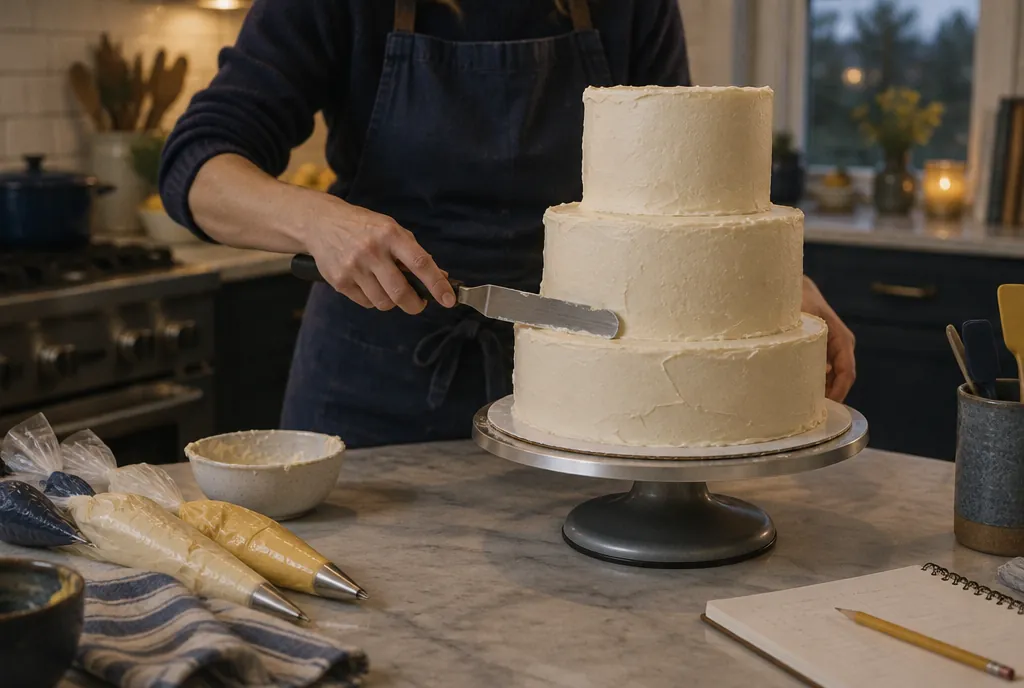
The sample cake sells for $755.23, or $11.62 a serving, delivered and set up. It is 3 tiers (5, 7 and 9 inch, the bottom tier three layers tall), vanilla and chocolate with buttercream, covered in fondant in 6 colors, with cut-out fondant decorations and a custom acrylic name topper.
| A | B | |
|---|---|---|
| 1 | Part of the price | Amount |
| 2 | Ingredients, supplies and the bought-in topper | $96.96 |
| 3 | Hands-on work, about 7.3 hours at $36.47 | $268.49 |
| 4 | Time and money around the cake (messages, store run, drive) | $198.89 |
| 5 | Markup, cushion and profit | $190.90 |
| 6 | Price for 65 servings | $755.23, or $11.62 a serving |
Ingredients are the smallest line. Under $100 of a $755 cake, so a price built from the grocery receipt prices the least of it.
Design sets the labor. Mixing, baking and filling grow with the servings; fondant colors and cut-out decorations don't. The cut-outs and name plaque are the biggest single block of time in the sample.
What you keep. After both wages and the overhead are paid, the cake leaves $148.14 of profit. Across all 11.3 hours of work, including the time around the cake, it brings in $53.72 an hour before wages, against the $10 an hour of the back-check above.
The full cost before markup is $564.33, so the price is about a 34% markup on cost, or a 25% margin on the price. Why those two percentages differ is in markup vs margin.
What cake makers charge per serving, by size and detail
Prices that experienced US cake makers shared, divided by the servings they said each cake feeds, fall in a wide band. These are owners' own prices, not an industry average, and a rural baker may not get what one in a big city gets.
| A | B | |
|---|---|---|
| 1 | Kind of cake | Rough per-serving range |
| 2 | Small single tier, 12 to 20 servings | about $13 to $20 |
| 3 | Two tiers, 25 to 30 servings | about $12 to $17 |
| 4 | Detailed three tiers, 65 to 70 servings | about $11 |
| 5 | Big, simple four tiers, 100 or more servings | about $5 |
| 6 | Our sample 3-tier cake for 65 | $11.62 |
The pattern matters more than the numbers. Small cakes cost more per slice because the design time and the fixed setup do not shrink, and big simple cakes cost less per slice because most of the work is mixing and baking, which grows with the size.
Minimum orders are common. Many custom cake makers set a minimum around $200, so a small cake still pays for the design talk, the store run and the washing up. Bakers who started at $2 to $4 a serving often say they were breaking even or losing money on every order.
Wages, markups and margins home bakers use
Home bakers who show their pricing use a handful of common settings. None of these is a rule; they are starting points to test against your own costs.
| A | B | C | |
|---|---|---|---|
| 1 | Setting | Common range | What it covers |
| 2 | Wage for baking and decorating | $15 to $21 an hour | Your pay only, not the business |
| 3 | Profit margin | 20 to 40% of the price | Depends on experience and location |
| 4 | Prime cost target | about 60% of the price | Ingredients, supplies and labor together |
| 5 | Card fees | about 3% plus 30 cents | Taken off the whole order |
A 100% markup on full cost is a 50% margin, which is a big gap from a 50% markup. New bakers often start their wage at local minimum wage and raise it as their skills and their waiting list grow. Card fees come off the top of the whole cake, so a $750 order paid by card loses about $22 before you see it. The spreadsheet shows a separate card price so you can pass that on.
Why a wedding cake costs more than the same cake for a birthday
A wedding carries tastings, a design meeting, a venue setup and a date that cannot move, and the price has to pay for that service. The baker cannot be sick and cannot be late, and that promise is part of what the couple is buying.
Pricing a wedding cake on food cost misses most of the job. The research gave no price for a tasting, so we don't quote one: cost it like a small order of ingredients, boxes and your time, or credit it against the booking so it turns into a deposit.
Delivery, the washing up and the backup batch: costs cake quotes skip
In the sample cake, the time and money around the cake add $198.89, nearly as much as the hands-on decorating. Most of it is time, which is why it goes missing: nobody hands you a receipt for it.
Delivery and setup. The biggest of them in the sample: driving both ways, carrying tiers in and finishing on site. A big tiered cake can start to lean after a short drive, so budget time on site for fixing it. Price the car at the standard mileage rate in the US, plus your hourly rate for the time. Pack a repair kit of buttercream, dowels and tools for the venue, and count it.
Messages, the design sketch and the quote. Answering messages is work every cake needs, just like baking and filling. A wedding inquiry with a page of inspiration photos can take more back and forth than the bake.
The store run. Your time in the store and the fuel, not just the receipt. If you do one big warehouse-club trip a month, spread its time and fuel across that month's cakes.
Small supplies. Baking paper, cake cards, gloves, paper towel, piping gel and edible glue. A box of 1,000 gloves costs a few cents a pair; measure what one tiered cake uses once and reuse that figure.
Packing and the box. Boxing, taping and labelling a cake takes longer than it seems, and it is the step bakers most often forget to time.
A backup batch. The extra ingredients bought in case buttercream splits or a layer sinks.
Washing up. Bowls, pans and piping tips after the fun part is done.
Extras added after the quote. One more flower, pearls, extra piping. Custom cakes are usually underpriced by lots of little extras that never made it into the quote, not by one big mistake. Price each before you make it (see change orders).
Five habits that keep cake makers at $2 to $4 a serving
- Pricing from ingredients aloneIn the example, ingredients, supplies and the topper together are about an eighth of the price.
- Quoting on the first callNever give a final price on the very first phone call. Send a written quote once the servings, design and delivery are checked.
- Doing detail work freeTime each decorating task once, so you know what a sugar flower or a painted tier really takes.
- Dropping the price to win the orderQuote firmly and let an over-budget customer go. Try raising quotes by $25 to $50 and watch the yes and no mix: if everyone says yes, you are too cheap.
- Discounting for friends by accidentA gift is fine if you decide it is a gift. Charging a friend only for ingredients is doing a favor, not running a business.
Cupcakes, cookies and cake pops: price by the dozen
Small bakes use the same method per piece, quoted by the dozen. Price each cookie or cupcake from its ingredients, its packaging and its timed labor, then multiply up. The spreadsheet shows a few order sizes on each quote, so a dozen and five dozen come from the same numbers and the setup time is spread over the order.
A quick example: if a dozen decorated cookies take 1.5 hours at $36.47 and $9 of ingredients and bags, the cost is about $64 before profit, or over $5 a cookie. That is why a $2 decorated cookie rarely pays.
Cost out your next cake in the sheet
The Custom Cake & Bakery Pricing Calculator works out your break-even rate, prices each cake from ingredients, timed tasks and bought-in toppers, asks about every cost above on every quote, and shows the price per serving at a few sizes, in Excel or Google Sheets. For setting a profit target see overhead and profit, and compare each quote with what the cake really took using job costing.