
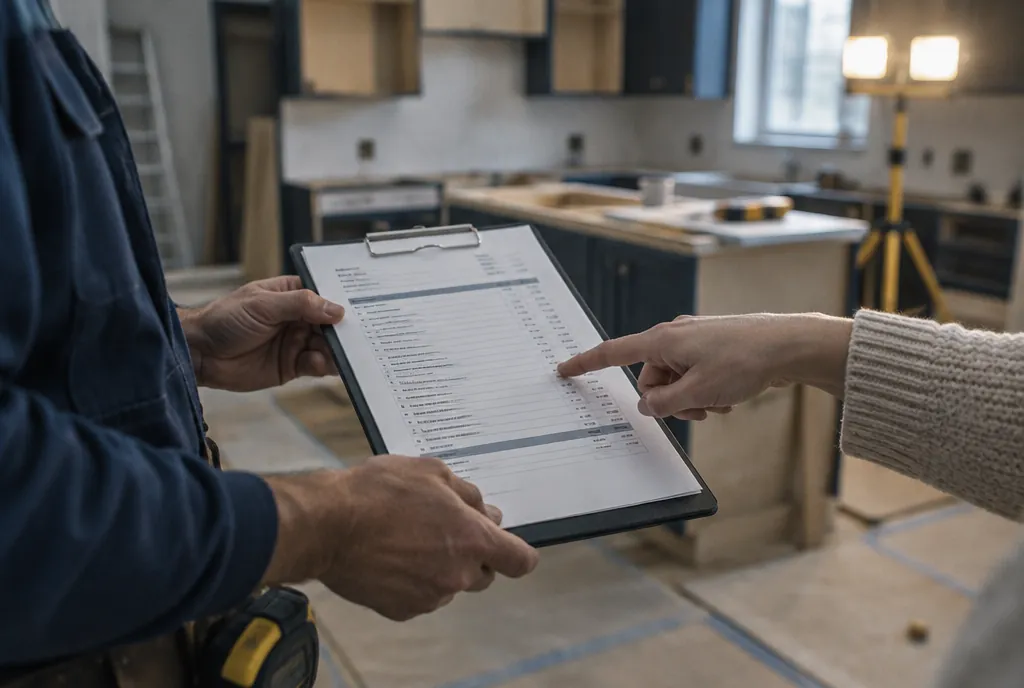
A quote (or bid) is 1 fixed price for a written scope that only changes through a change order; an estimate is a best guess, and the final bill can land above or below it. Give a quote when you can see and measure the job, and an estimate or a range when you can't.
The rules below come from how owners we studied in fencing, junk removal, cabinets, pressure washing, cleaning, plumbing and painting handle it, plus the sample jobs in our trade calculators.
Quote, estimate, range or hourly: who carries the risk
The type of price decides who pays when a job runs long: you on a quote, the customer on an estimate or hourly, both on a range.
| Type | What it means | Who pays if it runs long | Fits |
|---|---|---|---|
| Quote / bid | Fixed price for the scope written on it | You | Work you can measure: roofs, fences, paint, drywall, washing by the sq ft |
| Estimate | Best guess, billed on what it really takes | The customer | Repairs where you can't see inside |
| Range | Low and high number, final price inside it | Shared | Jobs you can't size from a photo |
| Hourly (time and materials) | Your rate x hours, plus materials | The customer | Service calls, open-ended work |
A fixed bid works both ways. Say you bid a fence at $6,000, planning 30 hours. Finish in 20 and the customer still pays $6,000; hit rock nobody saw and it takes 40, and the customer still pays $6,000. The price only moves through a written change order. That is why some owners print the word bid or quote at the top of every sheet, so nobody reads it as a rough guess.
When a customer wants a fixed bid broken into hours and parts, offer time and materials instead. Given the choice, homeowners often pick the firm price.
Which one to give, trade by trade
Most trades that price by a unit they can measure give fixed quotes, and they make that safe by pricing the common surprises in their terms. The sample prices are the example jobs in our calculators.
| Trade | Unit | Sample fixed price | How the unknowns are handled |
|---|---|---|---|
| Roofing | Per square (100 sq ft) | 20 squares, $14,599 (about $730 a square) | Rotten decking and a hidden second layer priced per sheet and per square |
| Fencing | Per linear foot | 150 ft cedar, $8,201 before tax (about $54.70 a foot) | Rock or old footings charged per post hole |
| Painting | Per job, built from rooms | Interior repaint, $8,663 | Fixed for the listed colours and 2 coats; more is a change order |
| Drywall | Per board foot | 3,488 board ft basement, $9,015 before tax (about $2.58) | Priced for the wall heights shown; $400 minimum on patches |
| Plumbing | Flat price per job | Main bathroom plumbing, $5,094 before tax | Service work often starts with a diagnostic fee, then a flat price |
| Pressure washing | Per sq ft | House + drive, $804 | A price per sq ft for house and concrete, with a minimum job charge |
| House cleaning | Per visit | Every 2 weeks, $256.55 a visit | First clean hourly, then a flat rate |
| Lawn care | Per visit | Weekly, $54.71 a visit | New beds, trees or gates mean a new price |
The priced surprises themselves are listed in the change orders guide.
When a range or an estimate is safer than a fixed number
If you can't see how big the job is, a fixed number is a bet against yourself. Take a junk removal job quoted at a flat $3,000 from a quick look. If it turns out to be six, seven or eight loads instead of three or four, every extra load is dump fees and crew hours you already agreed to cover. A range, like $2,500 to $5,000 depending on loads, keeps the risk shared.
The same goes for any job quoted from photos or over the phone: price it for the worst case you can reasonably expect, not the best, and say what the price assumes.
House cleaners solve it with timing. Charge the first clean hourly as a deep clean, then move the customer to a flat rate once you know how long the house really takes. The estimate comes first; the quote comes once there's data.
Why phone ballparks backfire
The first number you say becomes the number the customer wants, even when your real price is lower. Say you tell a customer around $10,000 on the phone for kitchen cabinets, then measure and come back at $6,000. You'd think that is good news, but the customer now doubts every number you give, and a customer who heard $6,000 and then gets $10,000 feels tricked.
If you must answer on the phone, give a range, say what it assumes, and say the firm number follows a look at the job.
What goes on a quote so the price holds
A quote holds up when the scope, the exclusions and the price of each known surprise are written on it next to one total. How to build the number itself is in the true hourly rate guide (with a free break-even calculator), markup vs margin and overhead and profit; each trade's pricing guide above applies it with that trade's numbers.
- Title, number and date. Quote or Bid, not Estimate, if the price is fixed.
- Scope in your unit. 150 ft of 6 ft cedar privacy fence with one 4 ft gate, not "fence".
- What's not included. A separate section listing everything you have not priced, so nobody assumes it's in.
- Prices for known surprises. Per sheet, per hole, per square, per extra hour.
- One total, plus deposit and payment timing. No hours or hourly rate on a fixed-price quote.
- How changes work. Extra work is priced and approved in writing first; there's a clause to copy.
- An end date. See the next section.
How long a quote should stay valid
Thirty days is a common choice; longer is fine only if you can hold your material prices that long. Some owners give line-item prices that last six months, which only works if you review them when your supplier's prices move. The supplier and sub quotes under your price should last at least as long as your own offer.
An old price with no end date gives money away. Say you planned about $1.75 a board foot on a drywall job of about 16,300 board feet, roughly $28,500, but the customer holds you to an older price near $22,000. You end up doing the same work for about $1.35 a board foot, and the $6,500 difference comes straight out of your profit.
What your win rate says about your quotes
If you win every quote you send, your price is too low; owners and advisers we studied aim to win somewhere between 30% and 70%.
| Trade | One source's target win (close) rate |
|---|---|
| Painting | 30 to 40% |
| Pressure washing | 40 to 70%; above 80% means prices are too low |
| Roofing | Closing every deal means your price is too low |
These are targets from single sources, not averages. Log every quote, won or lost, and check after the job with job costing: a high win rate plus jobs that run over is the clearest sign your quotes are too cheap.