
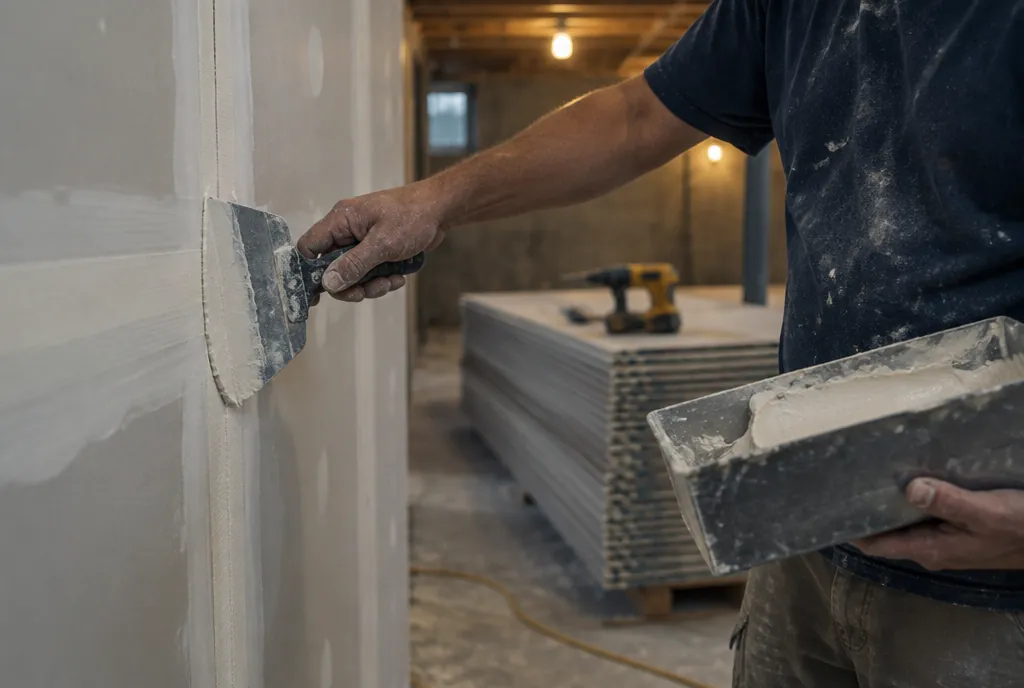
Why do drywallers bid by the board foot?
Drywallers bid by the board foot because board is the one thing on the job that grows with the job, so every bid gets the same yardstick. A board foot is one square foot of board as it goes on the walls and ceilings, not floor area. A 4x12 sheet is 48 board feet, a 54-inch by 12-foot sheet is 54, and a 4x8 is 32.
A quick shortcut for a first count is floor square feet times 5, then about 5% more for damaged board. Count real sheets on site before the price is final, and count them by type, because Type X and moisture-resistant board don't cost the same as regular half-inch.
The yardstick hides the hours, though. A good hanger can put up 30 sheets in a day on a simple job, yet the same person can need more than a day for 10 sheets when none of the prep is done and every wall is out of square. Same footage, three times the labour, so the hours have to be priced first and the per-foot number checked after.
Worked example: what does a 3,488 board foot basement come to?
The sample basement, 74 sheets on walls and ceilings with square metal corners and a smooth finish ready for paint, prices at $9,014.72 before tax. Most of the board is half-inch 4x12, with fire-rated Type X where the code wants it and moisture-resistant board near the plumbing.
The crew hours run from checking framing and backing, through hanging ceilings and walls, three coats and a sand with dust control, to touch-ups and the walk-through: 66 crew hours in all. The lift, stilts, sander and truck are charged for the hours they run. Board delivery and stocking down the basement stairs goes in as an outside cost with a small markup, and the forgotten-cost list adds about 12 more hours plus some cash.
| A | B | |
|---|---|---|
| 1 | Sample basement, 3,488 board ft | Amount |
| 2 | Materials, with 5% waste | $1,990.80 |
| 3 | Labour and equipment | $4,276.88 |
| 4 | Delivery and stocking | $175.00 |
| 5 | Forgotten costs | $888.63 |
| 6 | Markups, safety cushion and 13% profit | $1,683.41 |
That totals $9,014.72. Divided by 3,488 board feet it is $2.58 a foot, and divided by 74 sheets it is about $122 a sheet. Sales tax goes on top and varies by state.
The board itself is a small part of it: materials are about 22% of the price. Across roughly 78 hours, counting the off-site ones, the owner earns about $81.88 per labour hour once materials, equipment and outside costs are paid.
What does each hour in a small drywall shop have to cover?
The sample shop needs $60.30 per billable hour before any profit, because its $33,500 of yearly overhead and three people's full pay all land on the hours spent hanging, taping and sanding. It is an owner who also estimates, one hanger and one taper, and the owner bills the fewest hours since the takeoffs and the customer calls fall on him.
Another way to see it is per labour dollar. Once workers' comp, general liability, Social Security and unemployment are added, one drywall owner has to charge $1.47 for every $1 of wages just to keep 13 cents. The true hourly rate guide walks through that math step by step, and the free true hourly rate calculator does it for your own drywall crew.
Footage crews hide this. On new houses, hangers and tapers are often paid by the foot, around 30 cents each on one contractor's jobs, and up to 75 cents for hanging in another example. A shop paying hourly wages on cut-up remodels will land higher per foot, and that is a sign of different jobs, not a bad price.
Board-foot prices drywall owners have quoted
Owners have quoted from about $1.25 to $3.00 a board foot, and the spread follows job size more than skill. Each number is one person's example from their own market, not an average.
| A | B | |
|---|---|---|
| 1 | The job | Per board foot |
| 2 | Big new-house jobs, more with vaults | About $1.25 |
| 3 | New house, 8,039 board ft, subbed crews | $1.40 on $1.25 of cost |
| 4 | A made-up going rate: hang, supply and finish | $2.00 |
| 5 | One two-person crew's example, including hanging | $2.50 |
| 6 | A general contractor's custom house, late 2021 | $3.00 |
Bids on the same house can land anywhere from a dollar to two and a half. The math behind a higher number shows why. At $2.50 on 10,000 board feet the job is $25,000, hangers at 75 cents take $7,500, and the $17,500 left over 160 hours for two owners works out to about $109 an hour before materials. That crew does not typically charge under $100 an hour.
The low numbers come from big new houses with footage crews. Small projects or vaulted ceilings run higher, and the sample basement at $2.58 sits with the smaller residential work.
Markup on a drywall bid: 12% to 23% on cost
Drywall owners often work on thin markups: a $1.40 bid on $1.25 of cost is a 12% markup and a 10.7% margin, and some owners add 13% on top of cost. In the sample basement, the markups, a 5% safety cushion and 13% profit add $1,683.41, which is 23% on top of cost and 18.7% of the price.
On that 8,039 board foot house, the 15 cents a foot left over came to roughly $1,200, and it had to cover both profit and every mistake on the job. If profit also pays for the oopses, one bad ceiling eats it. That is why the sample carries a separate cushion. Why a 13% markup keeps less than 13% is covered in markup vs margin.
How much to charge for a drywall patch
Charge a minimum, not a per-foot price: a patch finished in under an hour plus a trip back to sand bills at around $400. At a $2 a foot going rate, a 32-square-foot sheet is $64 before materials, which can't pay for two trips, set-up and clean-up.
If you open a new bucket of mud for a patch and use half of it, the whole bucket goes on the job, because the rest will dry out in the truck. A box of mud runs about $20 to $25. The cleaner answer is one fixed price for small jobs, so the customer never sees a line for mud, and the sample calculator's minimum charge is set at $400 to match.
Dump runs, spare sheets and bad backing: what drywall bids leave off
On the sample basement, the forgotten-cost list adds $888.63, about 10% of the price and more than half of the $1,683.41 the job keeps. Most of it is time, and time costs the $60.30 rate, not a wage.
- A drive for every stage. A finish job is a hang day, three coats and a sand, and each one is a trip. On a job an hour away, crews need gas money too, and one contractor raised a bid by about $1,300 to cover it.
- Papering the floors. In a lived-in house the masking and moving furniture take real hours before the first sheet goes up.
- Scrap and the dump. Disposal can add 2 to 3 hours to a day plus a tipping fee at the gate. Some contractors budget about 10 cents a foot for scrapping out.
- Rooms nobody walked into. Skip a basement stairwell on the walk-through and you can end up more than a dozen sheets short, which is a real blow for a small shop.
- Prep the framer left. Price new customers for the worst prep you can imagine until you know their framers. Missing backing means adding studs before you can hang.
- No power on site. On a new build, ask whether you will need a generator before you finish the estimate.
- Dings after the painter. Touch-ups after other trades are real hours, so pad that line.
Two quote terms stop several of these at the door: say whether you or the builder supplies the board, and say that framing and backing must be ready before you start. The calculator comes with ready-made drywall terms for both.
Where drywall bids lost thousands
The biggest drywall losses come from prices set before anyone measured: an old promise, 8-foot prints and a missed detail.
An old price. One contractor's count said about $28,500 at $1.75 a foot, but he had promised $22,000 two years earlier and ended up doing the house for about $20,000, roughly $1.25 a foot, a break-even job. Put an expiry date on every quote.
Prints that lied about ceilings. A house bid from prints showing 8-foot ceilings turned out to have 9 to 10 foot ceilings with vaults, and a $17,000 price should have been about $26,000 to $27,000. The smaller version happens all the time: you assume eight-foot walls and find 8 foot 4 or 8 foot 6, which means 54-inch board or a rip strip to tape. Write the ceiling heights you priced on the quote, and bill anything taller as a change order.
A detail missed on the elevations. Missing the entrance reveals on a batch of houses can cost around $500 per reveal. List what the price does not include.
Bullnose, vaults and finish level: what moves the price per foot
Anything that adds corners, coats or lift time raises the per-foot price, and wrapped bullnose windows can run 15 to 20 cents a foot more than square ones. A big-job price near $1.25 goes up with cathedral ceilings and vaults, and 9-foot walls mean 54-inch board, which costs more per sheet.
Level of finish is the gap: we found no reliable level 4 or level 5 price, so we don't give one. Time the extra skim coat and the extra sanding on a few of your own jobs and price those hours at your rate.
After each job, compare the hours you bid with the hours you worked. A simple job costing habit shows which kinds of rooms eat your margin.
Price the next basement in the calculator
The Drywall Pricing Calculator takes your sheet counts by type, your crew hours and the forgotten-cost list, and returns the price, the price per board foot and a one-page customer quote, in Excel or Google Sheets.