
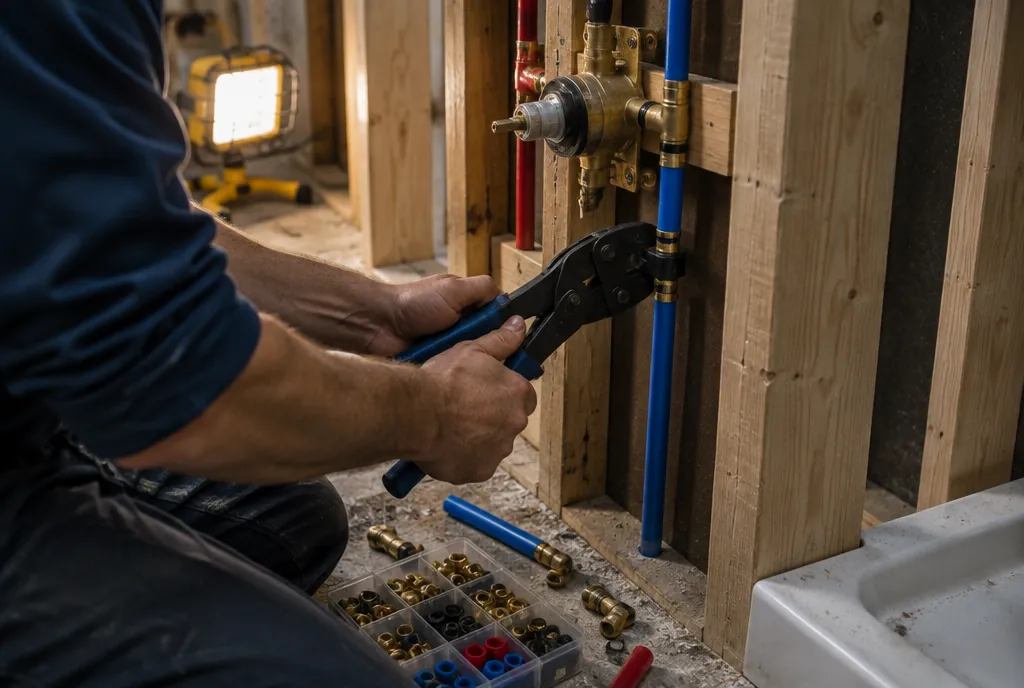
Flat rate, by the hour or per fixture: how plumbers sell a job
Service calls usually sell best at a flat price, remodels by stage, and the hourly rate stays underneath both. Customers tend to balk at a big hourly number, but they will say yes to a flat price once you have found the problem and told them what fixing it costs.
Hourly (time and materials) still has a job: hunting a leak or opening old galvanized, where nobody can say how long it takes. Per fixture is a check on remodels and new builds, not a way to price. Whichever you sell, the number traces back to hours at your real rate plus parts with markup. The plumber hourly rate page covers turning that rate into flat prices.
What does a bathroom rough-in and finish come to?
$5,094.45 before tax in our example, with the forgotten costs bigger than the materials. The job is in six stages: layout and drain-down, cutting the floor to reroute the toilet drain, drain and vent rough-in for the tub and vanity, water lines, the rough-in inspection, and the finish.
| A | B | |
|---|---|---|
| 1 | Part of the price | Amount |
| 2 | Materials and permit | $702.23 |
| 3 | Labour and van | $2,288.28 |
| 4 | The hours and parts around the job | $887.01 |
| 5 | Markup, cushion and profit | $1,216.93 |
| 6 | Price before tax | $5,094.45 |
That's about 41 labour hours door to door, and $99.46 earned per labour hour against a $69.95 break-even. The pipe is cheap; the hours around the pipe are not. Leave those out and the quote comes in about $1,100 lower, all of it out of your pocket. Sales tax goes on top and varies by state.
Pricing the bathroom one step at a time
Work down the job in the order you would do it, and give every step its own hours. Here is how the example bathroom is built.
- Count the parts. PEX and DWV pipe, the fittings, four quarter-turn shutoffs, the toilet flange, the shower valve and the tub drain kit. Add 5% for waste and cut-offs.
- Put hours on each stage. Two people on the layout, the floor cut, the drain rough-in and the water lines; one person for the inspection and the finish. Crew size times hours gives labour hours, and labour hours times the break-even rate gives the cost.
- Add the van by the day. The van is charged for the days it sits on site, not buried in the hourly rate, so a two-day bathroom pays for two days of van.
- Add the permit. The city fee goes on as an outside cost with a small markup for handling it.
- Answer the don't-forget list. Every line gets a Yes, No or N/A, and each Yes carries its hours or cost. In the example this step adds $887.01.
- Put markup, cushion and profit on top. The example marks parts up, adds a small safety cushion and a profit line, and checks the result is above the $250 minimum charge.
The result is a price you can defend line by line. If the homeowner asks why it is not $3,500, you can show them the hours, not just a number.
Is $69.95 an hour enough for a three-person plumbing shop?
It's the floor for our example, not the price. An owner who is also the master plumber, a journeyman and an apprentice, with about $55,300 a year of overhead, need $69.95 for every hour they bill just to cover wages and overhead.
The owner's hours are the catch: quoting, ordering and answering the phone are paid hours no customer is billed for. The van is priced apart from that rate, by the days it sits on site, so the bathroom pays for every day the van sits outside and a quick service call doesn't overpay for it.
The full working is on the plumber hourly rate page, and the free true hourly rate calculator runs it with your own numbers.
Hourly rates plumbers name: $55 to $325
The hourly rates plumbers mention when they talk about pricing run from $55 to $325. Each is one person's example, not a norm, and none of them tells you what your shop needs.
| A | B | |
|---|---|---|
| 1 | Rate | What it was |
| 2 | $55 an hour | One plumber's first rate when he started out, raised in steps over the years to $250 |
| 3 | $80 to $100 an hour | Where one trainer says customers start to push back on an hourly price |
| 4 | $116 an hour | The same trainer's standard time-and-materials rate |
| 5 | $325 an hour | A rate high enough that the customer watches the clock |
The spread is the point. A plumber charging $55 and one charging $250 can both be losing money or both be doing fine, depending on their costs and how many hours they really bill. The example's $99.46 per labour hour is simply what the bathroom earns once every cost and a profit line are in.
The seized valve, the parts counter and other hours plumbing quotes miss
In the example, the don't-forget list costs more than the materials and permit together. These are the ones plumbers keep coming back to.
- The tie-in that won't let go. A flat-priced faucet swap turns into a long afternoon when the old valve is rusted in place. Price the risk or say on the quote that seized valves are extra.
- The look before you quote. Measuring and writing up a remodel can take a good part of a morning, whether you win it or not.
- Runs to the supplier. The farther the job is from your supply house, the more each forgotten part costs you in drive time.
- Fittings the takeoff skipped. The 90s, couplings and adapters are what a quick count loses. Some estimators add an allowance of 30 to 50% of the pipe cost to cover them.
- Setup, floor protection and pack-up. Laying down a mat and putting on shoe covers in someone's home is time on every day of the job.
- Wood blocking for valves. The plans that show where blocking goes are not always the plumbing sheets, so it gets missed.
- Testing and two inspections. Rough-in and final are two trips, and a failed one is a third.
- Glue, primer, tape and solder. Nobody itemizes them and every job uses them.
The sample Job Log shows the cost of missing these: a $2,150 job quoted at 14 hours took 24 and lost $218.91. Time each item on your next three jobs and you'll have your own numbers.
Free estimates, one-price quotes and a smaller-shop discount
Most underpricing comes from habits, not arithmetic. Three stand out.
Free estimates. The hour you spend looking at a job is real work, so charge a service or diagnostic fee for it. If you waive the fee to win the job, build that hour into the job price instead of eating it.
One price instead of choices. Find the problem first, then lay out good, better and best options, such as a repair, a new valve, or a new valve plus new shutoffs. The customer picks, and you are not guessing which one they can afford.
Dropping your rate because you're a two-truck shop. A 30-truck shop spreads its office, software and marketing over far more billable hours, so its cost per hour can be lower than yours. Matching its price means working at a loss. Set your price from your own costs, then hold it.
Walls, tile and a surprise dishwasher: what the price leaves out
Write down what isn't included, and price anything added once work starts. On a bathroom the exclusions are usually patching walls and floors, tile, paint and electrical work. If they are not on the quote as excluded, the customer will assume they are included.
Scope grows on plumbing jobs. A kitchen rough-in picks up a dishwasher line, then an ice maker, then a coffee maker line, and each one is an hour or two you never priced. Hidden damage found once a wall is open, and anything the customer adds, gets priced and approved in writing first. The change orders guide covers how, and quote vs estimate covers which one you're giving. On bigger jobs, billing after the rough-in inspection passes and again at finish keeps cash moving.
Customer-bought fixtures need a line too. When the customer shows up with a toilet or vanity from the big box store, say on the quote that you install it as supplied and that any warranty claim goes to the maker. Otherwise a cracked tank a month later becomes your free callback.
What we don't claim about plumbing prices
We found no reliable residential parts prices or national plumbing rate, so we don't quote either. Supply prices change by region and by month, and your supply house account is the only price that matters for your quote.
The Plumbing Pricing Calculator holds your own supply prices, runs the don't-forget list on every quote, and compares quoted with actual hours in its Job Log. For reading those results, see job costing.