
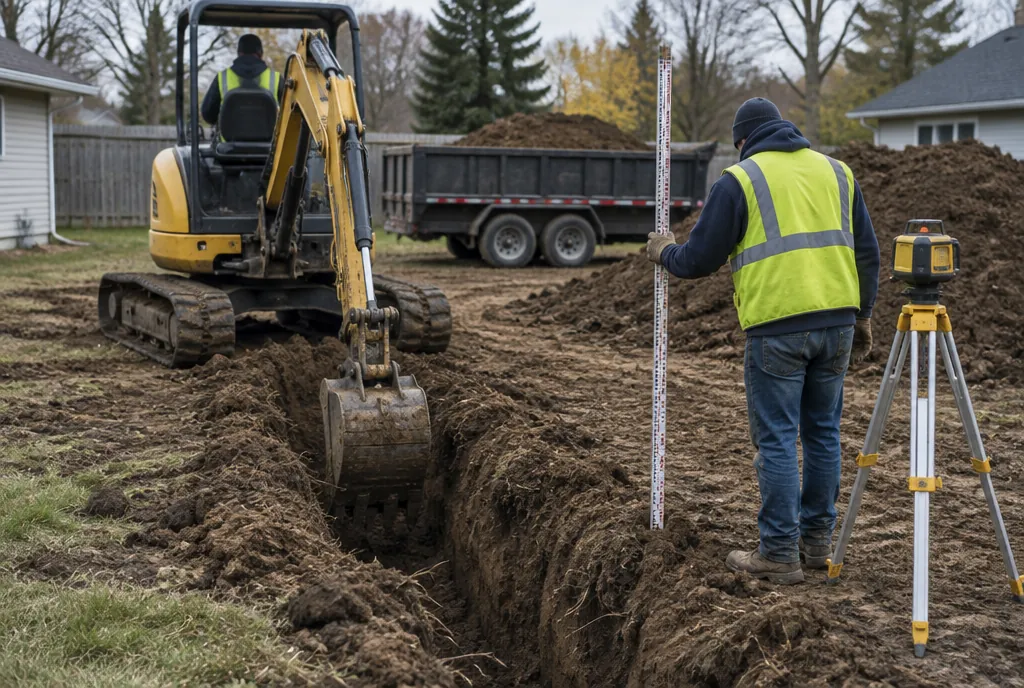
Why dirt work is sold by the machine hour
Excavation is priced by the hour because the machine and the operator are the product, and the dirt is often free or cheap. One Indiana owner quotes every machine with an operator: $85 for a mini excavator, $95 for a skid steer, $125 for a 12-ton trackhoe, plus about $10 more with a hydraulic attachment.
Even bid jobs are built from hours. Write them straight onto the proposal: 15 hours of subbase grading at $105 an hour, say. If the grading takes 16 hours, the customer already knows the price of the extra one. The hours on the bid do double duty as your change order.
What does one skid steer hour cost you?
A one-person skid steer outfit can need $85 an hour before it makes a cent of profit. One owner builds his floor from four pieces, all his own numbers:
| A | B | |
|---|---|---|
| 1 | Piece of the hour | One owner's skid steer |
| 2 | His own wage | $50 |
| 3 | Fuel | $20 |
| 4 | Maintenance | about $10 |
| 5 | Fixed costs ($10,000 a year over 2,000 hours) | $5 |
| 6 | Floor before profit | $85 |
A crew with more than one person needs two numbers. The sample company (an owner-operator, an equipment operator and a laborer who drives truck, with $42,100 a year of overhead) needs $66.75 per billable labour hour for people and overhead alone. Each machine then adds its own payment, fuel and upkeep divided by the hours it really runs, so a loader that sits half the season costs more per hour than one that works every day.
A quick one-man check: add up the monthly bills and divide by about 160 working hours. The full method, including why the owner's own billable hours are the lowest on the crew, is in the true hourly rate guide, and the free true hourly rate calculator runs it with your numbers.
Machine rates small dirt outfits charge
These are single owners' rates, useful as a check on your cost, not as a price to copy. Rental yards are the other benchmark new owners reach for.
| A | B | |
|---|---|---|
| 1 | Machine or job | Rate |
| 2 | 12-ton trackhoe or big dozer, with operator (Indiana) | $125 an hour |
| 3 | Skid steer / mini excavator, with operator (Indiana) | $95 / $85 an hour |
| 4 | Dump truck (Indiana) | $80 an hour |
| 5 | Skid loader on a grading job | $105 an hour |
| 6 | Skid steer rental, delivered and fueled | about $1,000 a day |
New owners often price their first jobs off the rental yard: about $570 to $670 a day for a skid steer, about $900 delivered and about $1,000 with fuel. A rental rate covers the iron. It does not cover you, your insurance, your truck and trailer, or the evenings spent writing bids.
Cubic yards or tons? Get the conversion right first
You measure the hole in cubic yards, but the pit sells stone by the ton, and the factor is different for every material. The sample lot is 22,050 square feet at 6 inches deep, 408 cubic yards, and at a factor of about 1.37 that is 561 tons of class 5.
Skipping that step is one of the most expensive mistakes in dirt work. Price a big pad in yards when the stone is sold in tons and you pay for about a quarter more stone than you priced, which on a big commercial job can wipe out the profit several times over.
Typical factors are about 1.5 tons per cubic yard for crushed limestone, 1.6 for granular fill and 1.8 for riprap. Fill that goes back in compacted needs about 22% more than what came out, and building pads are often made about 5% bigger than the footprint. Raising a 30 by 40 ft floor 8 inches, for example, took 58.6 tons of rock, four 15-ton loads, about $1,275 delivered.
If a customer wants a price per cubic meter, multiply your per-cubic-yard price by 1.31. Do the takeoff in the pit's unit first.
Worked example: pricing the 210 by 105 ft gravel lot
The sample job is a lumber yard's parking lot extension that forklifts will run on, and it prices at $26,433, with about $6,910 kept after every cost, the owner's wage included. The scope: grade the subbase with a crown, lay 10 rolls of filter fabric, then haul in, spread and compact 6 inches of recycled class 5.
Materials are the class 5 and the fabric, with an overage for waste and compaction. Class 5 can run about $8 a ton at the pit and about $6 more to truck it in your own trucks. Labour and machine time come to about 116 hours across mobilizing, grading, fabric, hauling, spreading and compacting, with hauling and spreading the stone the biggest share.
| A | B | |
|---|---|---|
| 1 | Part of the price | Sample gravel lot |
| 2 | Class 5, fabric and overage | $6,628.65 |
| 3 | Labour and machine time | $11,319.08 |
| 4 | Hidden costs (haul home, bid visit, tax, drive time, clean-up) | $1,574.76 |
| 5 | Material markup, cushion and profit | $6,910.06 |
| 6 | Price | $26,433 |
Over every hour on the job, the hidden hours included, the lot earns about $118.71 per labour hour against the $66.75 break-even. The real bid it is modeled on came to $23,995: subbase grading, 10 rolls of fabric, 561 tons of class 5, and spreading and grading it. The sample lands higher because it charges for the trip home and the sales tax at the pit.
Cushion, material markup and profit: how dirt owners stack them
Dirt contractors put three layers on top of cost, and each one does a different job. The cushion pays for the ground surprising you, the material markup pays for handling, and profit is what stays in the business.
- Cushion. A job that adds up to $5,000 goes out at $5,500. Some owners add 15% to every job, a tax on what they don't know yet about the ground.
- Material markup. Stone bought at $100 is resold at $110. Mark up hired trucking too, because you are the one coordinating the trucks and taking the risk.
- Profit. Add 20% for profit that goes back into the business. A small skid steer job of 7 hours at $85 plus $500 of dirt and trucking is $1,095 of cost, and goes out at about $1,314.
On the sample lot, $6,910 on $19,522 of cost is a 35% markup but only a 26.1% margin. Mixing those two numbers up is how dirt bids come in light; the markup vs margin guide has the conversion. And a warning for anyone tempted to cut price: at a 30% margin, dropping your price 10% means you need 50% more work to stand still.
The haul home and 7 more costs dirt bids leave out
Most losing dirt jobs are missing lines, not badly run. On the sample lot the hidden-cost list adds $1,574.76 of cost, all of it money that would otherwise come out of profit.
- Hauling the machine homeOwners charge for getting there and forget the trip back. A flat mobilization charge each way inside your radius covers both. Only skip it when the machine is already on site.
- Sales tax on the supply house quotePrice a pipe job from a pre-tax quote and the bill can come in 7% higher. Add tax to every material quote that didn't include it.
- Crew drive timeFew owners know what drive time costs them each week. It is paid every day and never shows up on site.
- Supply runs with the truck and trailerBill the truck and trailer by the hour on these trips, even without the machine on board.
- Morning grease, fuel-up and walk-aroundA few minutes a day is hours over a long job. Build maintenance into the machine rate so the iron pays for its own upkeep.
- The last 10%Dressing in edges, raking and the final pass always take longer than owners plan for.
- The bid visitThe hours at a desk phoning for material prices are real. Count them as labour on the jobs you win so they pay for the ones you lose.
To find which of these hit your own jobs hardest, compare each quote to the real hours afterwards with job costing. The fixed ones, like insurance and yard rent, belong in overhead and profit, not on the job.
Rock, spoils and extra work: put it on the bid
Anything you can't see before digging should be written onto the bid as time and materials. A line saying rock or unknown underground obstructions will be handled on a time and materials basis is what keeps a basement dig that hits ledge from losing money.
Spell out whether spoils stay on site or get trucked away, too, because trucking out dirt you priced to leave can wipe out a basement job. Write quantities on the bid (10 rolls, 561 tons) so a short roll is billed at the same unit price instead of coming out of your pocket.
Extra work while the machine is there is its own line. The customer's quick job down in the woods is never five minutes, and a request to brush hog a few more acres while you're there is a new job. Each addition gets a written change order, not a favor.
Per square foot, per ton or lump sum: checking the number
Customers compare dirt prices per square foot or per ton, so set the price from the job and then check it that way. The sample lot works out to about $1.20 a square foot and about $47 per ton of class 5 in place. The real $23,995 bid on a similar lot was about $1.09 a square foot.
That $47 is almost six times the $8 pit price, because most of the cost is machine time and trucking. A per-ton price copied from another contractor only fits if your haul distance and machines match theirs.
Build per-foot prices for repeat jobs like basements only after two or three come out where you expected, and still check each one with a full takeoff. A soft subbase, a long haul or a tight site changes the hours, so $1.20 a foot could lose money on the next lot. The difference between a firm price and a best guess is laid out in quote vs estimate.
Run the gravel lot with your own machines
The Excavation & Site Work Pricing Calculator does every step on this page in Excel or Google Sheets. It turns your crew, overhead and machines into hourly costs, prices stone and fill in the unit you buy them in, and makes you answer each hidden-cost line before the quote is done.
Its Job Log then shows whether each bid really paid. In the sample log, a basement dig that hit rock ran to twice its quoted hours, the job the rock term on the bid is written for.