
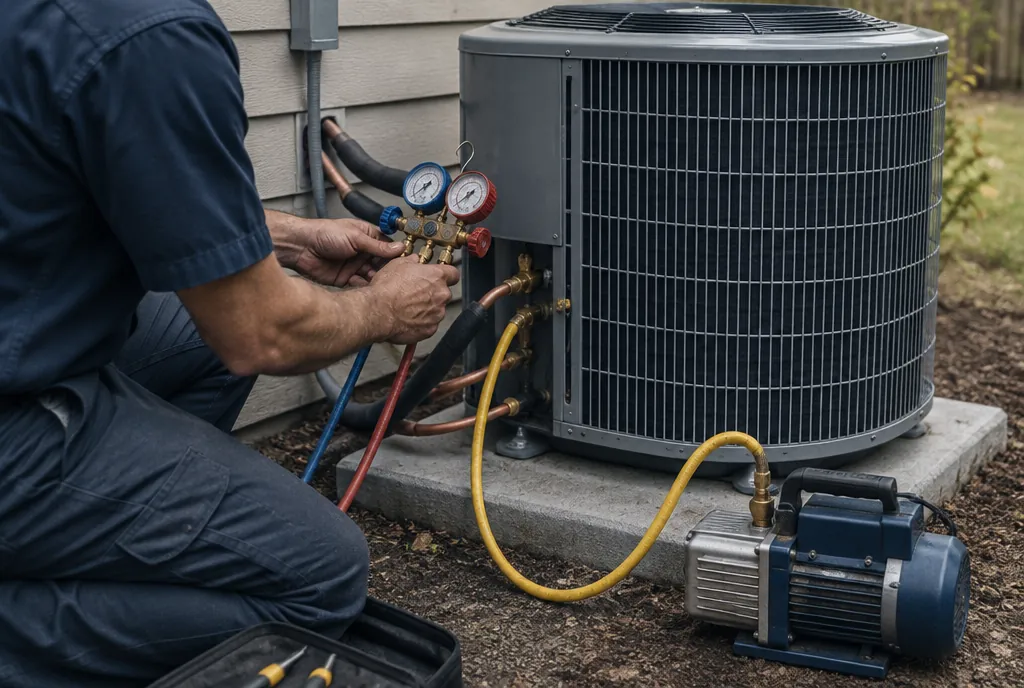
Why HVAC replacements sell as one system price
A replacement is sold as a finished system on a single price, because the homeowner is buying a house that heats and cools, not your hours. Many residential shops go out, measure, and then write four to six options, each with its own price.
That means every option needs its own math. A bigger condenser can drag in a larger line set, different venting or an extra hour in a tight attic, so a better system is more than a pricier box. Price each option from its own equipment and hours, then lay them side by side. The customer picks the system; you already know each one pays.
What a changeout price is made of
A changeout price has five layers: the three boxes, the kit that hooks them up, the crew day, the permit, and profit. Most of the money is the furnace, coil and condenser, which come to $3,775 together in our example.
The install kit is the part people shortchange. It is the thermostat, the whip and disconnect at the condenser, sheet metal to marry the new furnace to old duct, flue, drain line, filter rack, gas line and a lot of mastic and screws. In one teaching example that kit came to $611, a lot of money to lose if you only price the boxes. Price every part at what it costs you to buy today, not what you paid for the last one.
What each crew hour has to earn before profit
In our example shop, each billable crew hour has to bring in $79.81 just to pay wages, burden and about $93,500 a year of overhead. The shop is an owner who still runs installs, one installer and one helper, and most of that overhead is shop rent, insurance and a part-time person on the phones.
The hours that bill are what set the rate. A tech who bills half the day spreads the shop's costs over 4 hours, not 8, so the rate has to double to pay the same bills. Installers lose hours the same way, to loading, driving and waiting on parts. The full method is in the true hourly rate guide, and you can put your own numbers in the free true hourly rate calculator.
The one-day changeout, start to finish
The worked job tears out an old furnace, coil and AC, then sets an 80% 60k BTU gas furnace, a 3-ton cased coil and a 3-ton condenser on a new pad, with a new whip, disconnect and basic thermostat. Equipment and kit prices are made-up teaching prices, so put in your own.
The crew day is written out stage by stage: recovery and tear-out, setting the furnace and coil, the condenser, gas, flue and drain, brazing with a nitrogen pressure test and vacuum, then start-up. It adds up to about 20 crew hours, which fits the 8 to 14 hours on site that a two-person full install commonly takes. The van and the recovery and combustion instruments are charged to the job for the hours they are used.
| A | B | |
|---|---|---|
| 1 | One-day changeout | Amount |
| 2 | Furnace, coil, condenser and install kit | $4,346.22 |
| 3 | Crew labour, van and instruments | $1,639.69 |
| 4 | Mechanical permit | $100.00 |
| 5 | The hidden hours and supplies | $653.59 |
| 6 | Markup, cushion and profit | $3,424.96 |
| 7 | Price before sales tax | $10,164.47 |
With 6% sales tax the customer sees $10,774, and the deposit that releases the equipment order is $3,232. The $3,424.96 above cost is 33.7% of the pre-tax price, left after the owner has already been paid a wage. Spread over roughly 27 labour hours, the job brings in about $208 an hour.
The margin is built from three visible pieces, not one multiplier: a markup on what you buy, a small cushion for the day that goes wrong, and profit set before the job. If the customer pushes back, you know exactly which piece you would be giving up. How the pieces relate is in markup vs margin.
What the changeout examples we studied sold for
The changeouts in the pricing examples sold for between $7,100 and $12,594.74, depending on how much each one stacked on top of cost. These are single teaching examples, not market averages.
| A | B | C | D | |
|---|---|---|---|---|
| 1 | Example | The job | Cost or break-even | Sold at |
| 2 | Divide by 0.38 | One-day changeout, 2 people, 8 hours | $4,786 cost | $12,594.74 |
| 3 | Divide by 0.55 | Changeout with a $500 sub and $100 permit | $5,200 cost | $9,454 |
| 4 | 25% net on top | Changeout, 2 man-days | about $5,360 break-even | $7,100 |
| 5 | 35% net on top | $200 motor, 1 hour repair | $447 break-even | $680 |
| 6 | Worked example | One-day changeout, about 27 labour hours | $6,740 full cost | $10,164.47 |
The 0.38 divisor stacks 25% overhead, 25% net profit, 3% commission and a 9% financing dealer fee. It leaves room for a lot, but it still only holds if the day goes to plan. If the crew needs a second day or a return trip, a job priced that way can drop to break-even or a loss fast.
The $7,100 changeout shows how the extras add up. Financing lifts it to about $7,437, a $1,250 sub crew takes it to about $9,200, and paying a 7% salesperson takes it to about $10,000. The same kind of gap shows in hourly terms: one example puts a three-truck shop at about $351 an hour and a one-truck owner at $155, because a tech paid for 2,000 hours bills only about 1,000.
Why one multiplier on equipment misprices installs
A multiplier on equipment puts more overhead on a job just because the box costs more, while your office costs the same that day. Take a 30% overhead share: on a $9,454 changeout that is about $2,838, and the same math on a pricier unit or a two-day job gives a different overhead number each time, none of which match the real rent, phones and insurance for that day.
Service and installs also carry different overhead. Dispatch, the service van fleet and callbacks mostly belong to service, so an install priced on the whole company's percentage is carrying costs it did not cause, and the service side looks better than it is.
If you run both, give each its own numbers, or at least make sure installs are not paying for the service side. Pricing overhead by the hour instead of by the box is explained in overhead and profit.
The hours and supplies a changeout hides
On the worked changeout, the jobs around the install added about 7 hours and a few small cash costs, $653.59 in all. Leave them all out and the same rules price the job about $858 lower before tax, which comes straight out of profit. A fully loaded cost counts every hour the tech spends driving, writing options and following up, not just time with tools out.
The free estimate and the options. Measuring airflow, sizing the system and writing four to six options all happen before there is a job. You quote more systems than you sell, so the installs you win pay for the visits you lose.
Loading the van and the drive. Install day starts early with the equipment going on the van. Two people in a van are two people on the clock, both ways.
The supply house run. The fitting, breaker or piece of flue that was not on the van takes one person off the job and stalls the other. Put it in before you work out the sell price, not after.
Torch gas, vacuum and nitrogen. A small cash line used on every install, easy to forget because it never shows up as one big bill.
Commissioning and the walk-through. Checking the new furnace with an analyzer and tuning it to its rating takes time. Then comes the smart thermostat app, the Wi-Fi and the questions, usually when the crew wants to pack up.
Haul-away and the permit visit. Getting the old furnace, coil and condenser gone is not covered by the tear-out hours. The permit fee is easy to remember; the time to pull it and meet the inspector is not.
The warranty reserve. Setting a little money aside on each job for callbacks is sensible, but none of our sources gave a figure, so set it from your own callback history.
What goes wrong when HVAC jobs are priced by feel
Most HVAC pricing mistakes start with a number that was never built from cost. Three common sources of that number: what you would like to pay yourself, what the shop down the street charges, and a figure that felt right at the kitchen table.
Copying the cheaper competitor. Say your install is $6,000 and a competitor bids $5,000. You don't know their costs or what they left out, so compete on the warranty or a maintenance plan, not by matching them.
Stale distributor prices. When a part goes up 5%, pass it on, because eating it erodes margin one job at a time. Date every price on your list and recheck the old ones before you quote.
Rushing the clock. Pricing a one-hour task as 1.5 hours keeps the tech from working against the quote when a bolt seizes or the old coil fights coming out.
Forgetting the lender's cut. A financing plan can take about 9% as a dealer fee before you are paid. Add it on the quotes where the customer finances.
Mixing up margin and markup. A 45% gross profit means dividing by 0.55, which is an 82% markup on cost, not 45%.
Is $3,388 per ton a useful check?
Only as a smell test: the worked changeout comes to about $3,388 per ton of cooling before tax. Tons don't set hours, so a bigger unit in an easy basement can take less time than a small one in a crawl space.
When the old system comes out and the job needs an added return or a new circuit, it is no longer the job you priced. Put it on a written change order before the work, and be clear whether a number given before the site visit is a quote or an estimate. After the job, compare the hours you quoted with the hours you took using job costing: in the example Job Log, one install ran far over its hours and lost money.
Build your next changeout price
The HVAC Install Pricing Calculator runs this whole page in Excel or Google Sheets: your break-even rate on Shop Setup, equipment from your own Price List, the crew day by stage, every hidden line answered Yes, No or N/A, and a customer quote ready to send.