
Why laser shops quote by the set, not the minute
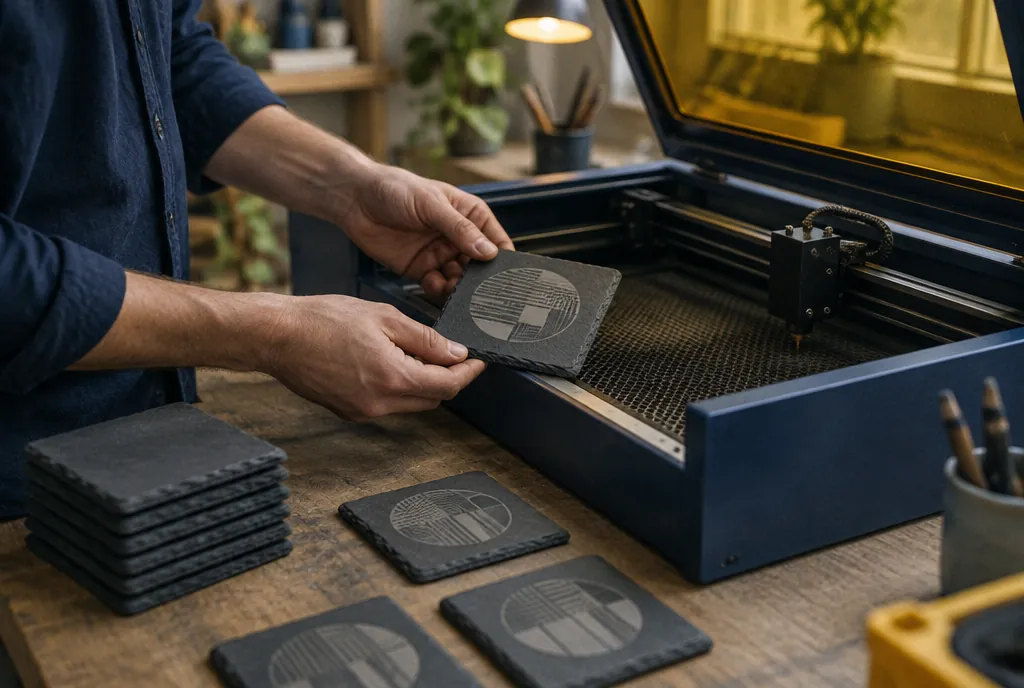
Customers compare laser work per piece or per set, so that is the number on the quote, but it should come out of the whole order. A 2-minute engrave on a coaster sits inside several more minutes of unboxing, taping, loading, wiping residue and boxing.
Here is how much that matters. Say a 4-coaster set sells for $25 and a 6-coaster set for $30. The 6-set takes half again as much slate and handling but brings in only $5 more, so if the 4-set earns about $100 an hour, the 6-set earns closer to $70. Same slate, same laser, same day: the difference is only how the price was built. Priced from the timed work, the 6-set would sit in the mid $30s.
Per minute still works as a check. Some owners charge about $1 a minute for handling and another $1 a minute of run time. On our sample shop, labour plus the CO2 laser comes to a little over $1 a minute before profit. Per square inch is weaker still: two logos of the same size can take very different time if one needs masking or a rotary.
What does a laser shop need to earn per hour?
Our sample shop needs $63.07 per billable hour just to break even, before the laser's own cost and before profit. That rate covers the owner, a part-time helper and $18,200 a year of overhead, spread over only the hours spent on paid orders.
Those unpaid hours are the big one in laser work: proof messages, ordering slate, stocking shelves and the mail drop. None of them shows up on a stopwatch at the laser, and all of them have to be paid for by the hours that do. Even a home shop should put a fair rent on its space, so prices don't have to jump the day you move into a real shop.
The method behind the $63.07 is on the true hourly rate guide, and you can run your own in the free true hourly rate calculator. Keep in mind that a shop rate is before tax. On a $35 rate, a self-employed owner keeps something closer to $25 once self-employment and income tax come out.
What does it cost to run a CO2 laser for an hour?
Price the laser separately, per hour it actually runs: what it costs you each year plus upkeep, divided by its running hours. Upkeep means tubes, lenses, exhaust filters, air assist and power.
A replacement CO2 tube runs roughly $300 to $500, and if the next tube isn't in your prices, you pay for it out of your own pocket the day the old one dies. Power is the small part: one owner measured his laser's electricity at roughly 25 cents an hour and padded it for wear. The point for diode owners is the same. The machine will need fixing or replacing one day, so part of its cost belongs in every item.
Running hours matter as much as the price tag. In the sample file the 60W CO2 laser costs $5.44 for every hour it runs. The rotary setup that only comes out for tumbler orders runs far fewer hours a year, so each of its hours costs $17.00. That is why the file gives every laser its own hourly cost instead of one rate for the whole shop.
Worked example: 50 slate coaster sets for a credit union
The sample order is 50 closing-gift sets of 4 slate coasters with the credit union's logo, boxed, priced at $1,389.38. Banks and credit unions order exactly this kind of set as closing gifts for new homeowners, which makes it a common first business order for a small laser shop.
The hands-on work runs wipe and load, engrave, then unload, wipe residue and box each set, about 5.25 hours in all. The blank order carries a $30 flat freight charge from the supplier, a common way blank suppliers bill small shops. The one-time extras (logo setup, proof, test coasters, a jig, the outer box, shipping) add 3.5 more hours plus some cash.
| A | B | |
|---|---|---|
| 1 | 50 coaster sets | Amount |
| 2 | Blanks, gift boxes and freight | $384.45 |
| 3 | Labour and laser time | $346.09 |
| 4 | One-time setup and extras | $284.10 |
| 5 | Markup, cushion and profit | $374.74 |
| 6 | Price for 50 sets | $1,389.38 |
That is $27.79 a set. The $374.74 above full cost is 27% of the price, left after the owner has already been paid. Take out the blanks, freight and cash costs, spread the rest over the 8.75 hours of work, and the order earns about $107.61 per labour hour, against a break-even of $63.07.
For comparison, business orders of 50 sets are often priced in the low to mid $20s a set with the setup fee billed on top. The sample's $27.79 already includes setup and shipping, so once you add a typical setup fee to those figures, the two land close together.
Why 10 coaster sets cost $59.61 each and 100 cost $23.81
The logo setup, proof, test coasters and jig cost the same whether the credit union orders 10 sets or 100, so small runs carry far more of it per set. The same sample file prices the order at four quantities:
| A | B | C | |
|---|---|---|---|
| 1 | Sets ordered | Price per set | Order total |
| 2 | 10 | $59.61 | $596.15 |
| 3 | 25 | $35.74 | $893.61 |
| 4 | 50 | $27.79 | $1,389.38 |
| 5 | 100 | $23.81 | $2,380.91 |
What the work earns per labour hour barely moves, from about $99 at 10 sets to about $111 at 100. What moves is the price each. Sending the customer this little table stops you from ever quoting 10 sets at the 100-set price, and it shows them why ordering more saves money. A fixed price like this is tied to the quantity and the proof they approve, which is the difference between a quote and an estimate (quote vs estimate).
The setup fee, spare coasters and freight that slip off laser quotes
Leave the one-time extras off the sample order and the same pricing rules come to about $20 a set instead of $27.79, more than $7 lost on every set. These are the extras laser owners in our research kept coming back to.
- Logo file prep. Turning a customer's blurry JPEG into a clean file sized for the blank can take longer than the engraving. Charge a setup fee and show it on the bill, rather than hiding it in the per-set price. Repeat orders with the same file skip it.
- Test engrave and spares. One coaster to dial in settings, plus a spare or two for the one that chips. On a 100-cup order, two extra cups is a sensible allowance.
- A jig for the blank. It takes design time and material, so charge it to the first order and keep it for the next.
- Masking tape and the time to apply it. A small handling charge can cover the mask and the extra minutes. Masking a big acrylic sheet can take longer than engraving it.
- Unpacking boxed blanks. Individually boxed cups take time just to open and inspect. It grows with every piece, so it belongs per piece.
- Wiping down the laser and loading new settings. Small, but it happens on every job, including the tiny ones.
- Postage. Customers want free shipping, but the box, the wrap and the label still cost you. If you offer it, build it into the price.
- Mail drop and supply runs. The sample leaves this line at No on purpose, so the quote keeps flagging it until you decide.
- Etsy fees. Marketplace fees take something like 15 to 20% before the money reaches you. Add it to the price, never take it from profit. On a direct business order like the sample, it does not apply.
Taking a deposit before you order slate means you never pay for the customer's blanks out of your own pocket. If the customer changes the logo after approving the proof, that is new setup time for a written change order.
$1 a minute or $40 an hour? Laser rates owners gave
Laser owners in our research price very differently, and each number fits that one shop's machine and market, not yours. Use them to test your own result, not to start from.
| A | B | |
|---|---|---|
| 1 | What the owner prices | Rate or price they gave |
| 2 | Handling and run time on a large production laser | $1 a minute handling plus $1 a minute run time |
| 3 | Own labour on custom one-off signs | $40 to $50 an hour, plus a 50% markup on cost |
| 4 | Machine time on cups | $60 an hour, about 2 minutes per cup |
| 5 | Coaster sets at retail | $25 for 4, $30 for 6 |
| 6 | 50 coaster sets for a business | $22 to $26 a set, setup billed on top |
| 7 | Small cork keychains | $5 each |
A price has to sell, but it also has to pay you for the piece. If your own number lands far below every row here, look first at the hours you left out.
Is 27% a good margin on a laser order?
Yes, for a 50-set business order: the sample keeps 27% of the price after every cost, including the owner's wage, which makes it close to net profit. That took a 36.9% markup on the $1,014.64 full cost, because a markup on cost is always a bigger number than the margin it leaves (markup vs margin).
A 50% markup on one-off signs is a 33% margin. One-off retail pieces carry more of the setup per piece than a 50-set run, so they need the higher number, and a small shop fee buffer of about 5% on top covers the surprises. How overhead and profit fit together is on overhead and profit.
The sample Job Log shows the other side. A 100-piece order for a realty firm ran well over its quoted hours and lost money, while the credit union order came in close to its hours and made a healthy profit. Same shop, same rate; tracking that is job costing.
Pricing only the laser minutes, and four other laser mistakes
The most common laser pricing mistake is charging for run time and forgetting the handling around it. On the sample coaster order the hands-on work takes about as long as the laser does.
Hiding setup in the unit price. Setup is the same for 10 sets or 100, so it belongs on its own line, charged once.
Racing other shops down. Every time you cut to match the cheapest listing, you get closer to a price that no longer covers the blank, the box and your time. Below that line, each order costs you money.
Folding when the customer balks. Some customers will act shocked at a fair price. Be ready to walk away, because a job that loses money is worse than no job.
Engraving customer-supplied items with no terms. Customer-supplied blanks cause more trouble than your own. Ask for a spare to test on, and put in writing what happens if a one-of-a-kind item is ruined.
Run your own coaster order through the Quote tab
The Laser Engraving Pricing Calculator turns your overhead and people into a break-even rate, gives each laser its own hourly cost, and asks every one of the extras above on every quote. It prices the order at four quantities for the customer quote, and the Job Log shows afterwards whether the order made money.