
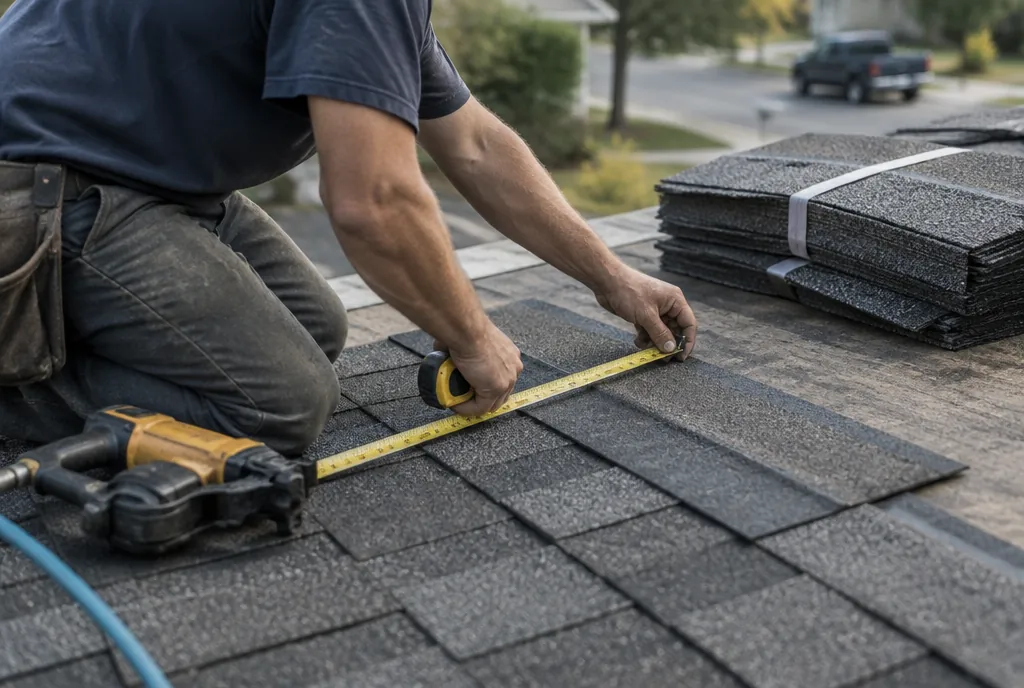
Why is a roofer's hourly rate so far above the wage?
A roofing crew hour costs far more than the wage because weather, supply runs and the owner's estimating days are paid but never billed. In most small roofing companies the owner is also the estimator, so much of the week goes to getting on roofs for quotes, chasing signatures and ordering material. Those hours still have to be paid for by the hours spent on a roof.
Say a roofer is paid for 2,000 hours a year and 500 of them go to estimate visits, supply runs and rain-outs. The company pays for 2,000 hours but can bill only 1,500, so every billed hour has to carry a third more cost than the wage suggests. Every hour a homeowner pays for carries the cost of the hours nobody pays for.
Put your own wage into the rate even in a year you don't take it home, or the company looks profitable while you work for free. The full break-even method is in the true hourly rate guide.
Workers' comp audits: the roofing burden that shows up late
Workers' comp is the biggest piece of labour burden in roofing, and the bill can grow after the season ends because the policy is trued up by audit. Owners who used more labour or subs than the policy assumed can get an audit bill at year end they never set money aside for.
The example company carries an audit reserve inside its overhead for that reason, and adds 15% of wage for comp and 12% for payroll taxes and benefits on top. Get your real comp rate from your carrier rather than borrowing another roofer's, because it moves with your state, your class codes and your claims history.
How much overhead does a roofing company carry?
Roofing business coaches commonly put overhead at 20 to 35% of every job, depending on how you operate, and the example company's comes to $83,800 a year, led by rent, marketing and insurance.
Overhead is everything that is not a roof's materials or a wage: the yard or warehouse, insurance, marketing, the office phone, software, fuel for the estimate truck, training, and the comp audit reserve. Every dollar of it has to be carried by the billable hours, so the fewer hours you bill, the more each one must carry.
Some owners also set parts of overhead as a share of sales rather than a fixed bill. Marketing at about 5% of gross sales, busy or slow, is one rule of thumb heard among roofers, and reps are often paid 8 to 15% of gross sales on the jobs they sell. Treat these as starting points to test against your own books, not averages. More on building overhead into every hour is in overhead and profit.
Which markup gets a roofer to a 30% margin?
A 43% markup is what it takes to keep 30%. On an $8,000 roof, a 43% markup adds $3,440, and the $11,440 price leaves just over 30% after cost. A 25% markup on the same roof keeps only 20%.
| A | B | C | |
|---|---|---|---|
| 1 | Margin kept on a roof | Markup on cost | Price that keeps it on $8,000 of cost |
| 2 | 10% | 11.1% | $8,889 |
| 3 | 20% | 25% | $10,000 |
| 4 | 30% | 43% | $11,429 |
| 5 | 35% | 53.8% | $12,308 |
The shortcut is to skip the markup and price straight from the margin: divide cost by one minus the margin. $10,000 of job cost divided by 0.65 is about $15,385 for a 35% gross margin, where multiplying by 1.35 would charge $13,500 and leave almost $1,900 on the table. The theory is laid out once in markup vs margin.
Is a 19.6% margin on a re-roof good?
Yes, against the common 10% net target: the worked 20-square re-roof keeps $2,862, or 19.6% of its $14,599 price, after every cost including the owner's wage. The calculator gets there with a markup on materials and outside costs, a small safety cushion and a profit percentage on top of full cost.
Be careful comparing it with a gross margin. Gross profit is what is left after materials and labour but before overhead, so a roof with 35% gross can end up at 10% net or less once the yard, the trucks and the office are paid. The example's 19.6% is after overhead and wages, so it is much closer to net.
From $68.55 an hour to a price per square
The rate turns into a per-square price through the hours each square takes: the example roof needs about 78 crew hours for 20 squares, and labour and equipment come to $5,622.54 of the price. Add materials, the dumpster and easy-to-miss costs, then markup, and it lands at about $730 a square.
That is about 3.9 crew hours a square. At the example's rate, each extra half hour per square on a 20-square roof is 10 crew hours, or $685.50 of cost before profit. Steep, high or cut-up roofs take more hours per square, so the same rate produces a higher per-square price there, which is why a flat per-square number loses money on them. The whole job is worked through on how much to charge for roofing.
Time your own crews on a few roofs of each kind, a simple gable, a hip roof and a steep two-storey, and your hours per square stop being a guess.
Set your roofing crew rate once
The Roofing Pricing Calculator works out your break-even rate on its Shop Setup tab and carries it into every roof you quote. Or try the free true hourly rate calculator first to see where your rate lands.