
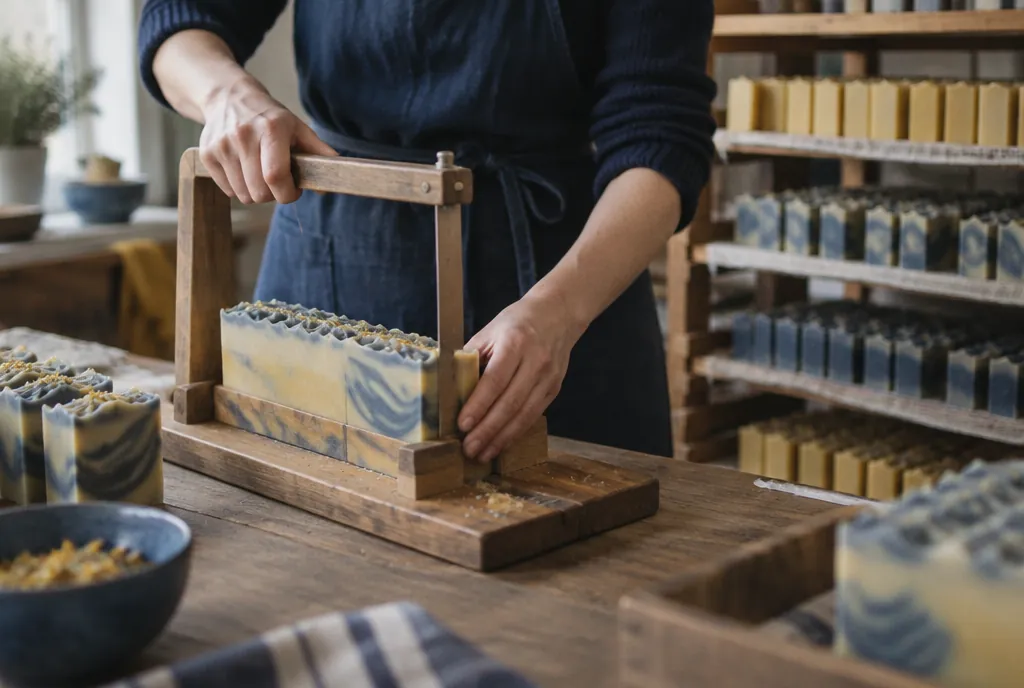
Why soap makers cost a bar by the ounce and the mold
Work every ingredient out per ounce, then per bar, because one mold of soap is one batch of bars. A gallon pail of coconut oil holds 128 ounces, so divide what you paid by 128 to get the price per ounce, multiply by the ounces in the recipe, and divide by the number of bars the mold makes.
Labour works the same way. If a helper paid $16 an hour makes one 16-bar mold in an hour, every bar carries $1 of wage before any payroll costs or overhead. Then come the pieces you count one each: the ingredient label, the shrink band or box, and a share of the shipping carton.
Essential oils move the number most. A luxury bar scented with three essential oils can come to about $3 a bar in ingredients and packaging, while a plain olive bar costs a fraction of that. In our sample, a 4.5 oz bar's oils, lye, scent, color and packaging come to a little over $2, before the printed logo band.
What does an hour at the soap pot have to earn?
The sample soap studio needs $36.11 for every hour spent making, cutting, curing and wrapping paid orders, before any profit. That covers the owner, one part-time soap maker and packer, and about $13,320 a year of overhead, spread over only the hours that go into orders.
Soap has an unusually small share of paid hours. Markets, photos, product descriptions, messages, ordering and washing up all take time, and none of it is making. Some makers reckon the making is only about a fifth of the work of running a soap business.
So $1 a bar is a floor for the wage alone. The sample's $36.11 is higher because it also pays for the selling hours and the studio. The steps from $13,320 of overhead to $36.11 an hour are laid out in the true hourly rate guide. To run that sum on your own soap studio, use the free true hourly rate calculator.
Worked example: 144 logo-banded bars for a realty office
The sample quote is 144 bars of 4.5 oz cold process soap in two scents of 72, cured 4 to 6 weeks, each with the customer's logo on a printed cigar band, an ingredient label and shrink wrap, shipped to their office, priced at $1,123.11. Business gift orders like this are where a soap maker quotes an order, not a bar.
The hands-on work runs from weighing oils and mixing lye to stick blending, pouring, cutting and beveling, turning bars on the rack, then banding and wrapping: about 8.6 hours for 144 bars. The logo bands come from a print shop with a setup fee and a price per band.
| A | B | |
|---|---|---|
| 1 | 144 bars, 4.5 oz cold process | Amount |
| 2 | Ingredients, packaging and printed bands | $359.83 |
| 3 | Labour and equipment | $315.63 |
| 4 | Don't-forget costs | $187.34 |
| 5 | Markup, cushion and profit | $260.31 |
| 6 | Price for the order ($7.80 a bar) | $1,123.11 |
Full cost is $5.99 a bar. The $260.31 on top is 23.2% of the price, left after the owner's wage is already paid. Spread over every hour the order takes, proofs and washing up included, it earns about $58.89 per labour hour against the $36.11 break-even.
Why 48 bars cost $12.28 each and 576 cost $6.12
The test batch, both proofs, the washing up, the band setup fee and the shipping cost about the same for 48 bars or 576, so a small order carries far more of them per bar. The sample file prices the same bar at four order sizes:
| A | B | C | |
|---|---|---|---|
| 1 | Bars ordered | Price per bar | Order total |
| 2 | 48 | $12.28 | $589.53 |
| 3 | 144 | $7.80 | $1,123.11 |
| 4 | 288 | $6.68 | $1,923.47 |
| 5 | 576 | $6.12 | $3,524.19 |
What the order earns per labour hour barely moves, from about $57 at 48 bars to about $60 at 576. What moves is the price per bar. Putting this little table on the gift quote stops a 48-bar order being priced like a 576-bar one, and it shows the customer why ordering more saves money.
Does 4 to 6 weeks on the curing rack change the price?
Yes, a little in labour and a lot in timing: every cold process order ties up rack space for weeks and needs a ship date set around the cure. Four to six weeks is the usual cure, longer for high-olive recipes, and a pure olive oil bar can need six months or more.
The sample counts the cure as its own step, a few seconds a bar to rack, flip and inspect, and puts the racks and dehumidifier in as equipment with their own hourly cost. The bigger effect is on cash. Oils, bands and boxes are bought weeks before the soap can ship, which is why the sample asks for a 50% deposit before anything is poured.
On the quote, start the cure clock only once the order and deposit are in, and print nothing until the logo proof is approved in writing. That makes the price a fixed quote for that order (quote vs estimate). A customer who changes scents after you pour is asking for a new batch, which is a change order.
Test batches, failed loaves, washing up: costs soap quotes leave out
On the sample gift order the don't-forget lines add $187.34, about $1.30 a bar; leave them all out and the same rules price the order near $887 instead of $1,123.11. These are the ones soap makers name most often.
- A small test batch for each new scent. A fragrance can speed up trace, discolor or fade, and finding out in a full loaf costs the whole loaf. Test new scents in a batch of just 100 to 150 g of oils first.
- The batch that seizes, cracks or separates. A new maker who tries three recipes can easily lose one to failure and another to a fragrance that sets too fast. A flat line on each order pays for the one that goes wrong.
- Freezer paper, cups, gloves and paper towels. The paper that lines the mold, the disposable cups for mixing colorants and what you clean up with afterwards are small, but they are on every batch.
- Washing up between scents. Pots, stick blender and molds get cleaned after each scent so they don't mix, so a two-scent order washes up twice.
- Loaf ends, bevel shavings and bars that fail the cure. You paid for every ounce and can't sell it at full price.
- The ingredient label and its rules. Labeling rules for soap and cosmetics are not optional. Writing and proofreading the ingredient list for each scent takes time, and makers selling in Europe also pay for safety assessments.
- Store commission. Some shops take up to 50% of the price. If your bar was priced for your own table, that cut comes straight out of your wage.
- Your time selling. Market days, samples and calls can take more hours than the making. The sample leaves this line at No on purpose, so the quote keeps asking until you decide.
x3, x4 or keystone? What soap makers charge
Handmade bars commonly sell for $6 to $12, and the multiplier each maker uses depends on what they count as cost. Use these to test your own result, not to start from.
| A | B | C | |
|---|---|---|---|
| 1 | Rule or price | What it counts | Example |
| 2 | Cost x3 retail, x2 wholesale | Ingredients and packaging | A $2 bar at $6 retail, $4 wholesale |
| 3 | Cost x4 retail | Ingredients, labels, disposables and labour | A $3 bar at $12 |
| 4 | Keystone | Wholesale at half of retail | An $8 bar at $4 to a shop |
| 5 | Private label | Co-packer volume | about $1.50 to $2.00 a bar |
Common retail prices from makers run $6 to $10 a bar at markets, and $10 to $11 when a store is taking a commission. A $12 price on a bar that costs $3 to make feels high to a new maker, but once the hours and the studio are counted it is often what the bar needs.
The sample's $7.80 lands inside the usual $6 to $10 market range. It gets there without a multiplier, because its cost already holds the hours and the one-off costs that a multiplier is meant to cover.
Is 23% a good profit margin on handmade soap?
Yes, for a gift order priced from full cost: the sample keeps 23.2% of the price after the owner's wage and the studio's overhead, which makes it close to net profit. A 3x price on ingredients leaves a 67% margin on paper, but the labour, website and photos that were left out of the ingredient cost still have to come out of that 67%.
Wholesale is where soap margins get thin. At the sample's $7.80, keystone wholesale would be $3.90 a bar, well under the $5.99 full cost, so a shop order needs its own quote at its own quantity. A bar that looks like it makes $6 profit at retail may really leave $2 once the hours, the booth and the website are paid.
One safe approach is to run the business as if every bar sold at wholesale, and let the extra from retail pay for marketing and equipment. Why a markup is always bigger than the margin it leaves is on markup vs margin, and how overhead and profit fit together is on overhead and profit.
Soap pricing mistakes: ingredient-only costs and 50% store cuts
The first soap pricing mistake is pricing from the oils alone. Close behind are copying other sellers' prices without knowing their costs, and trying to compete on price with factory soap from the supermarket.
Leaving your own hours out. Soap that doesn't pay the maker gets dropped the first busy season, and the customers who loved it lose their soap maker.
Selling through stores at your market price. Keeping the price low while a store takes up to half of it can leave almost nothing per bar. Either raise the retail price so half of it covers your cost, or quote the shop separately.
Not tracking what an order really took. In the sample Job Log, a 96-bar order for a gift shop was planned at 9 hours and took 15. It was meant to make $90 and lost about $172. Writing down real hours after each order is job costing, and it is how the next quote gets better.
Quote your next gift order in the soap sheet
The Soap & Bath Products Pricing Calculator turns your studio's overhead and people into a break-even rate, costs each bar from your own oils and packaging by the ounce, and asks every don't-forget line above on every quote. It prices four order sizes for the customer quote, with soap terms on cure time and proofs already written, and the Job Log shows afterwards which orders made money.