
Man-hour or crew-hour: which rate do tree owners use?
Both work, as long as you know which one you're quoting. One owner builds a man-hour rate of $75 and multiplies by his crew of three for $225 an hour; another skips the per-person step and prices $575 per crew-hour.
A crew-hour rate is easier to use in the yard, because you're timing the tree with the whole crew on it. A man-hour rate is easier when crew size changes, like two people on a trim and four on a big removal. The sample spreadsheet works in labour hours and multiplies by the people on each piece of the job.
Where $65.13 per labour hour comes from
The sample break-even is its yearly overhead plus the full cost of the crew, divided by the hours that crew spends on job sites. The crew is an owner who climbs, a second climber and two groundworkers, and overhead is $48,100 a year in total.
The number people get wrong is the hours. Only hours spent on a job site count. Shop work, washing equipment and sharpening chains are all real work, but no customer pays for them directly, so they have to be carried by the hours that are billed.
In tree work the owner loses the most: estimates, the phone, dump runs and the books all come out of climbing time. Workers' comp is the other big swing, since tree work sits in a costly class and no owner we studied gave a rate, so get yours from your carrier. The general method is in the true hourly rate guide, and the free true hourly rate calculator runs it with your numbers.
What a chipper and bucket truck add to every hour
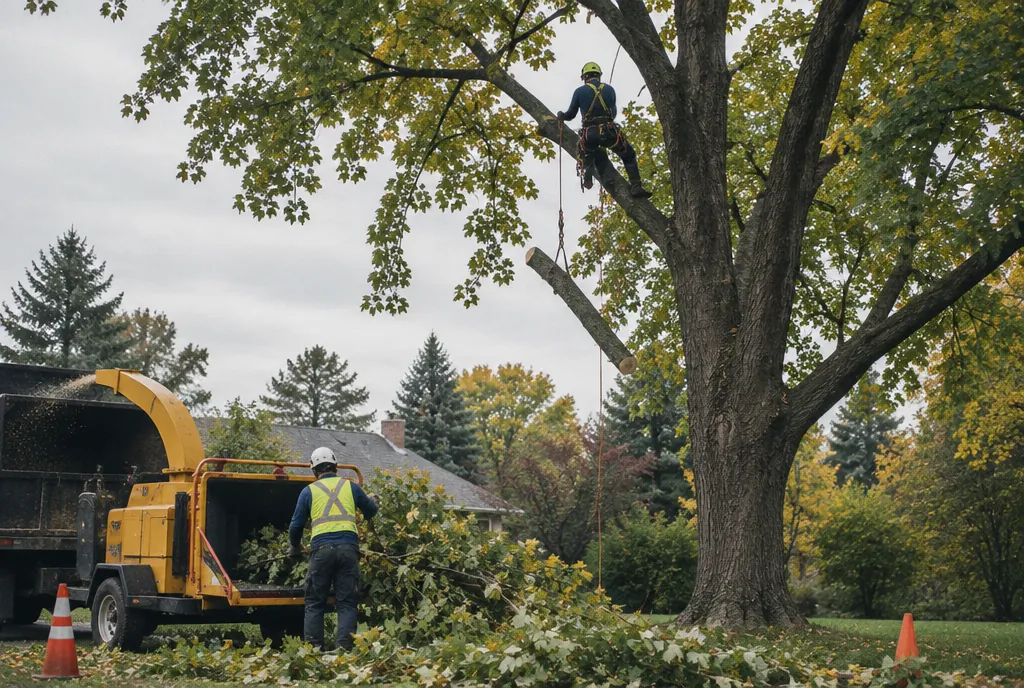
Equipment is the reason a tree rate can't be built from wages alone. One small crew counted a $50,000 chipper replaced every 5 years, a $65,000 bucket truck kept 10, pickups at $60,000 each and a $10,000 dump trailer every 3 years. That is about $31,833 a year, roughly $10 a man-hour for a crew of three.
A bucket truck costs you money whether it is up in a maple or parked at the shop. The payment, the insurance and the inspections keep running on rain days and slow weeks, so the hours it does work have to pay for the ones it doesn't.
The sample spreadsheet gives each machine its own cost per running hour, so a ladder trim doesn't pay for the bucket truck and a full-day removal pays for the chipper it keeps busy. Rentals sit outside the rate: a 38-ton crane at about $1,200 for an 8-hour day is about $150 an hour on top of the crew.
Crew-hour rates tree owners shared
These are single owners' numbers, not market averages.
| A | B | C | |
|---|---|---|---|
| 1 | Rate | What it covers | Where |
| 2 | $75 per man-hour ($225 for 3) | About $64 of costs at a 50% margin, plus about $10 of equipment | A three-person crew, Northeast Ohio |
| 3 | $85 and $135 an hour | Other local companies in the same market | Northeast Ohio |
| 4 | $325 per crew-hour | Break-even: $650,000 a year over 2,000 working hours | A larger crew |
| 5 | $575 per crew-hour | The same crew's break-even plus profit | A larger crew |
| 6 | $400 a day | What one owner pays his climber | Minnesota |
The Ohio owner says his own $75 is a little low for his area, which is a useful reminder that a rate heard online may already be too cheap where it was set. The sample removal sells at about $621 per hour on site for a crew of four, closer to the larger crew than to the Ohio one.
Is a 50% margin realistic for a tree service?
It is for owners who count their own pay inside it, and it's a stretch for anyone who has already paid themselves a wage. Getting to 50% means doubling your costs, a 100% markup. A 10 to 20% profit on top of every cost is the more modest target some owners set, enough to survive a lean month or a mistake.
This is where a lot of tree owners go wrong. They add a markup and think it is their margin. Add 50% to a $2,200 cost and the price is $3,300, but the $1,100 you keep is only a third of the price, not half.
Here is what each target does to the sample job's $3,256.71 full cost:
| A | B | C | |
|---|---|---|---|
| 1 | Margin kept | Markup needed | Sample removal price |
| 2 | 10% | 11.1% | $3,619 |
| 3 | 25% | 33.3% | $4,342 |
| 4 | 50% | 100% | $6,513 |
The sample actually priced at $4,348, about 25%, after the owner's wage is already in cost, so it sits nearer net profit than gross margin. The conversion itself is in markup vs margin, and where profit ends and overhead starts is in overhead and profit.
Why tree owners keep the hourly rate off the customer's quote
The hourly rate prices the job, but the customer sees one number. Billing tree work by the hour punishes a fast crew and makes a slow day look like stalling, so most owners we studied rarely do it.
The rate still matters after the job. Check how many hours you bid against how many the job really took. A tree bid at 24 hours that runs to 40 is how a good rate turns into a losing season. The Tree Service Pricing Calculator keeps that record in its Job Log next to the rate it was bid at.