
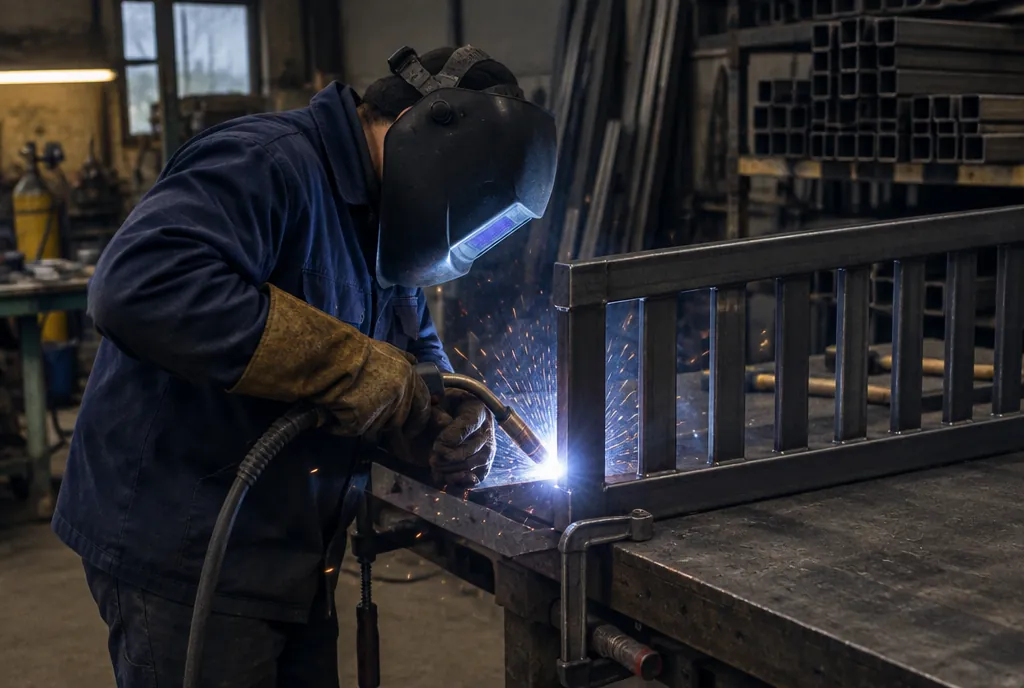
Shop hour or mobile hour? What working welders charge
Working welders we heard from charge about $65 to $75 an hour in the shop and $80 to $120 for mobile work, and every one of them says it depends on the area. These are single welders' numbers, not averages.
| A | B | |
|---|---|---|
| 1 | Area | Rates we heard |
| 2 | Florida | About $100 an hour field work, $65 to $75 an hour in the shop, per man |
| 3 | Not stated | $80 to $120 a mobile hour from the welders around one owner, who charges $100 |
| 4 | Oklahoma | No less than $60 an hour for a rig and welder, some at $85 or more |
| 5 | Rural Arkansas | $40 to $50 for repair, $50 to $60 structural, and more than double the repair rate in California |
| 6 | Not stated | $100 a mobile hour, built from $50 of cost plus 50% |
The spread is the point. In rural Arkansas a repair hour and a California hour differ by more than double, for the same bead. Your area decides what customers will pay.
Your cost sets the floor and the market sets the ceiling. If the ceiling sits below your floor, fix your costs or your speed, not the price.
Why a mobile welding hour costs more than a shop hour
A mobile hour has to pay for the rig, the fuel and the drive, so in the Florida example it runs about $25 to $35 above the shop rate. Welders with little more than an engine drive in the back of a pickup tend to sit at the bottom of the range, around $50 or $60. A full tool set and real fab skills are what let a mobile welder charge $100.
The simplest version of the math: if your costs, wages included, come to $10,000 a month and you bill 200 hours, each hour costs $50. Add 50% because your market allows it, and you charge $100. In the sample sheet, the mobile welding rig is set up as equipment with its own running cost per hour, so rig hours carry it and shop hours don't.
The $63.33 every sample shop hour has to bring in
The sample fab shop, an owner, one welder/fabricator and a part-time helper, breaks even at $63.33 per billable hour on $52,100 of yearly overhead. Below that, every hour loses money, before any profit.
The gap between a wage and what an hour really costs is bigger than most new shop owners expect. An employee paid $16 an hour can cost you $50 to $55 for every hour they are working on a job, once payroll tax, insurance, their unbilled time and the shop around them are paid for.
The owner's hour is the most expensive, because so much of the week goes to quotes, steel runs and the books. Picture a 40-hour week where only 10 hours get paid: at $100 an hour, that week brings in $1,000, which is $25 for every hour you worked. The formula, and why billable hours matter most, is in the true hourly rate guide; run your own in the free true hourly rate calculator.
How to estimate welding time on a railing, gate or run of parts
Break the job into cut, layout and jig, tack and fit, weld out, and grind, then split one-time steps from per-piece ones. A jig takes as long for 1 panel as for 16; welding out repeats on every panel.
A good habit is to sit down with photos of the site and walk through each step in order: getting steel, cutting, running a string line, capping posts, getting the parts into the backyard. For work you haven't done before, ask a more experienced welder how long they would take. Then pad it a little, either by bidding $110 instead of $100 an hour or by adding two or three hours to a 10-hour estimate.
The per-piece arithmetic is simple: 20 minutes a piece is 3 pieces an hour, so 100 pieces is about 34 hours before setup. Process choice moves time and cost too. In one side-by-side test on the same fillet on 3/8 plate, short circuit MIG cost about $7.28 a foot and metal core about $3.95, shop rate included. That was one test at one set of settings, so treat it as a reason to time your own welds, not as a benchmark. Compare every job's real hours with the bid, as covered in job costing.
Worked example: 8 powder-coated deck railing panels
The sample quote prices 8 railing panels, 6 ft each, at $4,395.26 and keeps $1,022.26 after every cost including the owner's wage. The panels have 1-inch pickets, a 2-inch top and bottom rail, bolt-down posts and black powder coat, and are built in the shop, not installed.
| A | B | |
|---|---|---|
| 1 | Line | Amount |
| 2 | Steel, shop time and powder coat | $2,852.67 |
| 3 | Site trip, drawing, steel run, gas, abrasives and the rest of the checklist | $520.33 |
| 4 | Full cost | $3,373.00 |
| 5 | Markups, 5% cushion and 20% profit | $1,022.26 |
| 6 | Price | $4,395.26 |
The shop work is about 19 hours, and 24.4 hours once the checklist hours are counted, which earns about $106 per labour hour. Install is left as No on purpose, so the sheet warns you, and the customer quote says install is priced separately.
Per panel, per foot, or per job?
Customers compare railing by the foot or the panel, so set the price from the job and then check the per-unit number, never the other way round. The sample works out to $549.41 a panel and about $92 per foot over 48 ft. There is no reliable per sq ft fabrication rate to copy, so we don't quote one.
Quantity changes the unit price because the site trip, the drawing and the jig get spread out:
| A | B | |
|---|---|---|
| 1 | Panels | Price each |
| 2 | 1 | $1,384.38 |
| 3 | 4 | $668.69 |
| 4 | 8 | $549.41 |
| 5 | 16 | $489.77 |
For a quick repair, use a minimum charge so a 30-minute job still pays for the drive, the setup and the invoice. A repair that pulls you off a planned job costs you more than its own half hour, because the planned job now runs late too.
Markup on steel: 5% to 35%, depending on what sits on top
Welders add anywhere from 5% to 35% to steel, and the right figure depends on what else sits on top. Some mark up material and consumables 20 to 35%. Others add only 5 to 10% to material and put 20% on their time as a fail-safe. Another common way is 20% for consumables, then 10% profit on labour and steel together.
The sample keeps its steel markup low because cushion and profit already go on top of full cost. The result is a 30.3% markup that keeps 23.3% of the price, right at the common floor of a 30% markup on hourly cost. Why those two percentages differ is in markup vs margin, and what counts as profit once the owner is paid is in overhead and profit.
Site trips, steel runs and powder coat drives: what welding quotes leave out
The costs that sink fab quotes are the unpaid trips and the small consumables, not the steel. The sample's checklist adds $520.33 to the railing job; each line needs a Yes, No or N/A.
- Site check, including level and grade. Gates built to a measurement that ignored the slope of the drive come back for rework on site, and that time can't be billed. Posts that land a little out of level are the same problem.
- Drawing and cut list for sign-off. Start every project with a sketch and a cut list or bill of material. It also settles arguments later about what was agreed.
- Working out the steel and fetching it. On a job of a day and a half, calculating, ordering and handling the delivery can easily add two hours nobody sees.
- Gas, tips and nozzles. Work out what your shop burns through for every labour hour and build it into the rate, so it is never a surprise.
- Cut-off wheels, flap discs and saw blades. A chop saw blade worn down on stainless will smear carbon steel, and the rest of the cuts go slower with a grinder.
- Spare steel for bad cuts and drop. Adding 5 to 10% on material is common. Stick length matters too: 10 ft sticks can leave one piece short where 12 ft sticks would have covered it.
- Round trips to the powder coater. Loading, driving, dropping off and picking up, twice, shows up on nobody's invoice.
- Install and paint repair. A job two hours away is four hours of driving before you strike an arc, and a lived-in home needs its own kind of cleanup. Bring paint for the scratches.
Welding pricing mistakes that cost fab shops
The mistakes that cost welders most are pricing like an employee, copying a competitor's rate, and winning too many bids. If every customer who calls says yes, your price is too low, not your service too good.
Copying the shop down the road. A shop charging more per hour may run faster equipment and still make the part for less. Their hourly number only makes sense with their machines behind it.
Buying steel before the customer says yes. Get the material price, set the job price, and buy nothing until the customer approves it and pays the deposit. Otherwise you are holding steel for a job that may never happen.
Doing "while you're here" jobs for free. The customer who asks you to fix one more thing while you're on site is asking for more work. Write each addition up as a change order, even a small one.
Pricing the weld and not the job. A railing is mostly cutting, fitting, grinding, finishing and driving. Price only the weld time and the rest comes out of your pocket.
Deposits, install and site changes: terms fab shops use
Fab quotes need three protections: a deposit before steel is bought, install priced as its own line, and a charge for refitting when the site changes. The sample asks for 50% down, enough to cover the steel and the powder coat so the shop never funds a customer's job.
For anything deeper than a quote from a picture, some shops take a small appointment deposit and credit it to the job, so a week of site visits doesn't turn into ten hours of paid work. If you give a rough number before measuring, call it an estimate, not a quote; quote vs estimate explains why.
Price your next railing in the spreadsheet
The Welding & Fabrication Pricing Calculator does every step above in Excel or Google Sheets. It holds your break-even rate and equipment costs, prices four quantities at once, asks every checklist line, and builds a customer quote with your deposit and terms. The Job Log then shows whether the job made money.