
$85 a man-hour: what a paver crew's rate has to carry
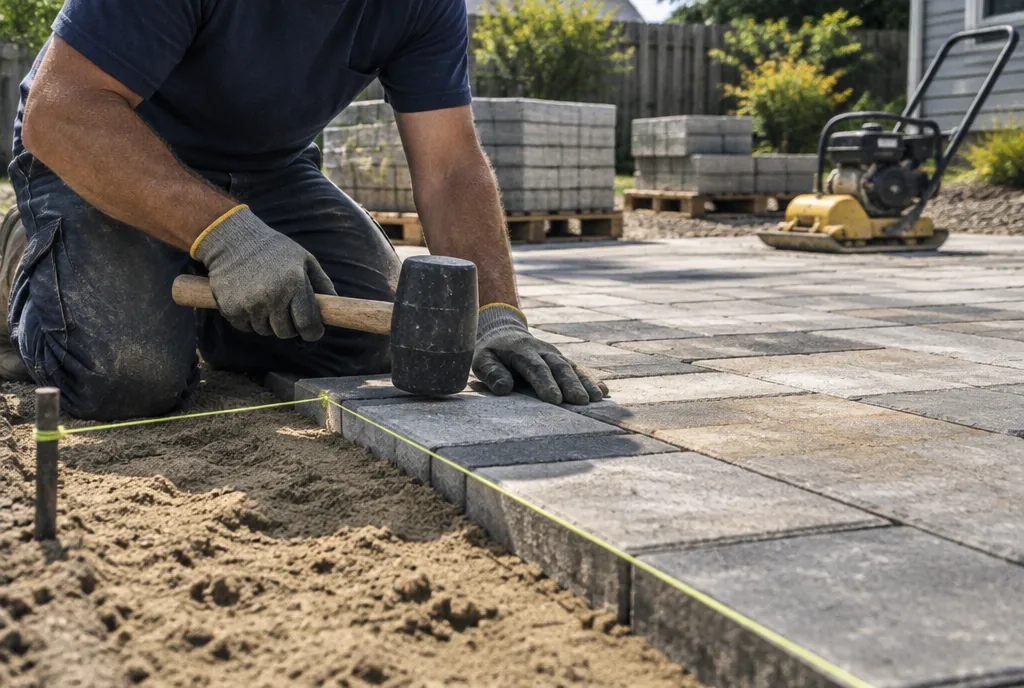
A paver crew's hourly rate has to pay the wage, the burden on it, a share of a year's overhead and a profit, all from the hours actually spent on site. The $85 rate includes all of that. His 525 sq ft patio took 64 man-hours, so labour alone came to $5,440.
The sample company, an owner, a crew lead and two labourers, carries $48,700 of yearly overhead. Divided with the crew's full cost over the hours they really bill, that is $59.47. The formula and how to count billable hours honestly are in the true hourly rate guide; put your own crew into the free true hourly rate calculator to see yours.
The sample then earns about $108 per labour hour on its 400 sq ft patio once markup and profit are on. The owner's pay is already inside the $59.47, and profit is a separate line on top. Business profit is not your salary: it is what the company earns after you have been paid.
Why an 8-month season pushes a hardscaper's rate up
A hardscaper who works only part of the year has to recover twelve months of costs in fewer billable weeks, so the hourly rate goes up. Work 8 months because of winter and each working month has to recover half as much yard rent again as it would over twelve.
The same logic hits the crew. If labourers are paid only in the working season, you have fewer hours to spread insurance, the trailer, the phone and the winter storage over. A $2,000 monthly insurance bill spread over about 20 working days is $100 on every day the crew is out, whether it rains or not.
Labour burden on a patio crew: about 30% on top of wages
Labour burden is what an hour costs you on top of the wage: payroll taxes, workers' comp, insurance and vacation pay. Hardscape owners often add about 30%. Two people at $50 an hour combined for 11 hours is $550 in wages, and $715 once 30% burden is on.
Some owners work it out as a day rate instead: payroll, taxes, comp and insurance for one five-person crew came to $927 a day. Workers' comp for hardscape work varies by state and class code, so take yours from your carrier.
Equipment by the running hour, not buried in the rate
Machines are best charged per hour they run, on the stages where they run, instead of padding everyone's hourly rate. That is how the sample does it: the $59.47 has no equipment in it, and the excavator, skid steer, compactor, saw, dump trailer and truck each carry their own cost per running hour.
A hand-dug walkway then doesn't pay for the excavator, and a big dig does. Owned equipment still has to be replaced one day; if it isn't charged to jobs, the replacement comes out of your pocket. Some landscape owners simply carry equipment as a flat cost per day on site, around $200.
Is the 50% rule a markup or a margin?
It is a margin: owners who "work at 50%" double their direct cost, which is a 100% markup. Many hardscape owners treat a 50% gross margin as healthy for patio work.
The catch is what goes into "cost" before you double it. Doubling only materials and field labour leaves the office, the trucks and your admin time to come out of the margin. Doubling every cost, admin and equipment included, is a much safer price.
The sample does it the other way round: overhead and the owner's wage are already in its hourly rate, so the markup, cushion and profit on top keep 27.7% of the price, and doubling its direct cost lands within half a percent of the same number. More on the two measures in markup vs margin and overhead and profit.
| A | B | C | |
|---|---|---|---|
| 1 | Rule | Markup on cost | Margin on price |
| 2 | Add 30% to materials | 30% | 23% |
| 3 | Add 50% to cost | 50% | 33% |
| 4 | The sample, all in | 38% | 27.7% |
| 5 | Double direct cost (the 50% rule) | 100% | 50% |
Materials markup: 30%, or the retail price
Many hardscape owners add about 30% to materials, and some simply charge retail. At 30%, $2,940 of patio materials goes on the quote as $3,822. Charging retail means the markup is the gap between the contractor price and the retail price of the same pavers and base, which the customer can check for themselves.
Deliveries, disposal and rentals often get a smaller markup than materials, since they are pass-through costs with less handling. The sample marks materials up 30% and pass-through costs less.
Rates by season, job size and market
Hardscape rates move with the season and the size of the job, not only with costs. Some companies raise margins about 10% in the busy summer and lower them in the slow months to keep crews working.
Job size matters too: the same margin on a bigger ticket is more money for similar setup and selling effort, which is why some landscape owners say their best jobs sit in the $3,500 to $7,500 range. And a price well above your market will stop closing, even if the math says you need it, so check your win rate in the Job Log. The per-square-foot results these rates produce, from $17.64 to $42.70 a square foot on real patios, are on how much to charge per square foot for a paver patio.
The Hardscape & Landscape Pricing Calculator works out your break-even crew rate from your overhead, crew and season, gives each machine its own running cost, and applies your markups on every quote.