
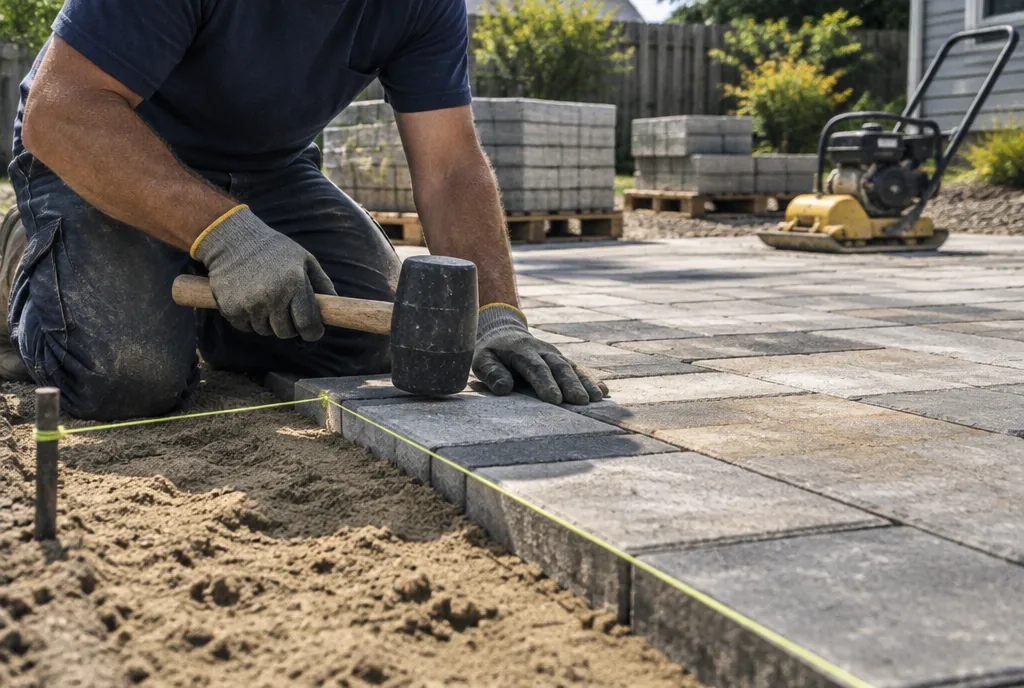
Why hardscapers price labour by the hour and pavers by the foot
Materials are bought by the square foot, ton and bag, so they are priced that way; labour changes yard to yard, so it is priced in crew hours. A square-foot price is a fine way to count pavers and a poor way to count the time it takes to put them down.
Three things move the hours most: the soil, the dig depth (8 inches on one job, a couple of feet on another) and access. If you can't back the truck up and have to run a skid steer around the house, the same 400 sq ft takes far longer. A big slab also lays faster than small 4x8 stones.
One installer's production number is about 1.5 people-hours per 100 sq ft to excavate a backyard patio 10 inches deep with a machine. That is his crew and his machine, so track your own on the next three patios and use the average.
The 400 sq ft patio and seat wall, priced out
The sample job is a 400 sq ft paver patio on a 6 inch compacted base, a 20 ft curved seat wall 18 inches high, polymeric sand, and sod along the lawn edges. The sample company is an owner, a crew lead and two labourers, working a short season.
The patio and wall take about 67.5 crew hours over three days on site, split into layout, excavation, base, laying, cuts and edging, the wall, poly sand and clean-up. Each machine is charged only on the stages where it runs, so the excavator pays its way on the dig day and nowhere else.
| A | B | |
|---|---|---|
| 1 | Sample 400 sq ft patio + seat wall | Amount |
| 2 | Materials with 10% waste | $3,969 |
| 3 | Crew labour and equipment | $4,633 |
| 4 | Deliveries and spoil disposal | $930 |
| 5 | Easy-to-forget costs | $1,350 |
| 6 | Markup, 5% cushion and profit | $4,160 |
| 7 | Price before tax | $15,042 |
The $4,160 above cost is 27.7% of the price, left after the owner's wage is paid. Across 85.5 hours, including the hours nobody sees, the job earns about $108 per labour hour against the $59.47 break-even. How that rate is built is on how much pavers charge per hour.
As a cross-check, many patio builders just double their direct costs. Done on the sample, doubling lands within half a percent of the sheet's price, which is a good sign nothing big was left out.
What patio installers have charged per square foot
Owner numbers run from about $17 to $43 a square foot, and the gap is explained by job size, base depth and what each owner counts.
| A | B | |
|---|---|---|
| 1 | Job | Price per sq ft |
| 2 | 100 sq ft patio, 8 in base, Canada (CAD) | $42.70 |
| 3 | 525 sq ft patio, 64 labour hours, New York | about $17.64 |
| 4 | Sample spreadsheet: 400 sq ft patio with seat wall | about $37.60 |
| 5 | Residential retaining wall, per sq ft of face | $28, later $32 |
The small Canadian patio was built from $1,420 of materials and 11 hours for two people plus 30% burden, a direct cost of $21.35 a square foot, then doubled. Its builder's point: a competitor quoting at or under the direct cost is cutting corners somewhere, and per-foot prices come down as patios get bigger because the setup and the dig don't grow as fast as the area.
The New York patio was priced as $2,940 of materials plus a 30% markup, and 64 hours at $85 per man-hour, for $9,262. That owner says many installers just use $20 a square foot without knowing their numbers. His base is 6 inches; builders in freeze-thaw country often dig for 8 inches, and about 4 inches is common further south. Base depth alone can move the tons, the dig and the spoil by a third.
How to price a retaining wall by the square foot of face
Walls are priced per square foot of face: length times average height, plus the course buried below grade. Put at least one course below grade, and count every return and all the embedment when you measure.
One wall builder's residential market price went from $28 to $32 a square foot of face over three years, and commercial sites paid about half that. Write "approximately" in front of the measured square feet, and list extra spoil loads at a set price per load. That line protects you when the dig turns out bigger than the math said.
A worked method for a 4 ft by 20 ft wall: equal amounts of materials and labour, plus a day rate for overhead, with 30% on top. One builder's hypothetical came to $5,850 that way, about $73 a square foot of face. Treat it as a way to build the number, not the number itself. Geogrid, backfill stone and a 12 to 18 inch base under the first course all belong on the quote, and wall block often gets a price break at four pallets, so order the whole wall at once.
Driving, setup and the extra load of spoil: what patio quotes leave out
On the sample patio, the easy-to-forget costs add $1,350 before markup, and most of it is crew time. The list: the site visit and design, the locate call, driving the crew, fuel, loading and setup each day, supply runs, a buffer for rain or a redo, lawn repair from access, saw blades, leftover pavers from a full bundle, and a warranty reserve for settling.
The drive, times the whole crew. Charge for the gas and for the driving time. Count days on site times people in the truck times the round trip. On a three-day patio with a crew of four, that is twelve round trips of paid time.
Loading the trailer and packing up. Setup, breakdown, breaks and lunch are all paid hours. If your production rates come from the hours with tools in hand, the rest of the day is missing from the price.
The dig, fluffed. Soil grows once it is dug. Multiply compacted yards by about 1.25 for the loose volume, then by roughly 1.35 to 1.5 to get tons. A small 100 sq ft dig can still fill about 4 yards of bin, and the tipping fee comes with it.
Rain, redos and roots. Build a buffer into the schedule. Some builders price a one-day job as a day and a half in case something has to be redone. If the job goes well, the buffer is profit.
Special-order pavers. Some pavers come only by the full bundle, and you pay for what you buy, not what you lay. Pallet delivery has its own fee too, and picking them up yourself costs truck time.
Where patio margins go: short seasons, loose scopes and no job costing
Most hardscape money is lost on things that aren't pavers. Pricing by adding up materials and keeping whatever is left over means every slow day comes out of your pocket. Set profit before the job, not after.
The season is the next trap. A crew that works 8 months a year has to recover twelve months of yard rent and insurance in those 8, so each working month carries half as much again as it would over a full year. A crew that bills only in the warm months must charge more per hour than one that works year round.
The scope is the third. Anything not mentioned on the quote is not included, and it is safer to talk about start dates than to promise an end date in a rainy spring. Rock, buried debris or an unmarked private line found in the dig belongs on a written change order, and whether to send a fixed quote or an estimate is in quote vs estimate.
Last, check the finished job. Compare estimated and actual hours and materials after every job, and ask whether a gap was an estimating mistake or waste on site. See job costing.
Is doubling direct cost the right markup for a patio?
Doubling direct cost is a 100% markup, and it leaves a 50% gross margin, not 50% profit. Overhead and the owner's pay come out of that half. Adding 50% instead leaves only 33%. The difference is explained in markup vs margin, and the rates and markups behind the sample are on how much do pavers charge per hour.
The Hardscape & Landscape Pricing Calculator does every step above in Excel or Google Sheets: your break-even crew rate, materials by the unit you buy them in, labour and equipment by stage, the don't-forget list, and a customer quote with ready-made hardscape terms. Run your own rate first in the free true hourly rate calculator.