
Why pest control is sold by the month but priced by the minute
Customers buy pest control as a plan, per month or per year, but what the plan costs you is time on the property and time getting there. Product is the small part: in our example it is about $6.60 of a $107.68 visit.
So every price should start from your average service time, and that time has to include everything: the drive, setup at the truck, the treatment, cleanup, notes and paperwork, and talking to the customer. An average residential service often runs 45 to 60 minutes once all of that is counted.
Pull the last four to six visits at similar homes from your CRM, or time a few with your phone, and that becomes the number every price is built on.
What a pest tech's hour costs once driving and mixing are counted
In our example company, an owner and one technician, each billable hour has to bring in $59.80 before any profit. That covers both wages with payroll taxes and workers' comp, plus $24,000 a year of overhead led by chemical storage, marketing and pesticide liability insurance.
Neither person bills anything close to a full year, because mixing, loading, quoting, CEUs and answering the phone are not time on a property. A good aim is to bill at least half your paid time. A solo owner who pays themselves $60,000 and carries $30,000 of overhead, billing about 960 hours, needs over $90 an hour just to break even. Put your own numbers in the free true hourly rate calculator, or read how the formula works in the true hourly rate guide.
The worked example: a quarterly perimeter service on a 2,200 sq ft home
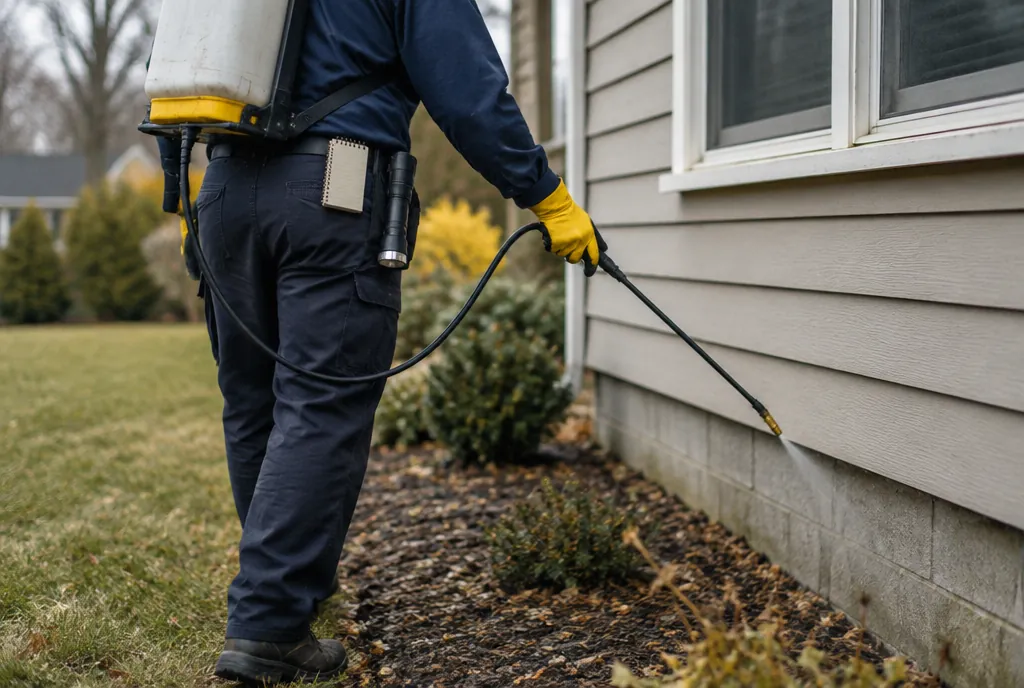
The example stop is a single-family home on quarterly general pest: walk the perimeter and talk to the customer, backpack spray the foundation, doors and windows, sweep the eaves for wasps and webs, lay a granular band, then spot-treat inside if asked. It is the standard visit a new operator would recognise: backpack sprayer on, walk the property, sweep the eaves.
All in, the stop takes about 69 minutes of labour, and a third of that is the drive and the small jobs around the treatment, not spraying. Product, sprayer wear and the drive are added, then a markup on product to cover mix left in the tank, a small cushion for the stop that runs long, and 20% profit.
| A | B | |
|---|---|---|
| 1 | Quarterly visit, 2,200 sq ft home | Amount |
| 2 | Full cost to deliver one visit | $84.14 |
| 3 | Product markup, cushion and profit | $23.54 |
| 4 | Price per visit | $107.68 |
| 5 | Billed monthly over 12 months | $35.53 |
| 6 | First-year total with the initial | $627.50 |
The visit keeps $23.53 above full cost, which is 21.9% of the price, and the owner's wage is already paid inside that cost. Across every minute of the stop it earns about $80.67 per labour hour against the $59.80 break-even. The same visit sold every two months or monthly spreads over more visits a year, so the monthly price rises with frequency.
Why the initial service runs about twice a quarterly visit
The first visit is priced on its own because it is a different job: inspection, finding the source, and a first treatment that usually takes about twice as long as a regular visit.
Don't discount it to win the account. A cheap initial means the heaviest visit of the year is done at a loss, and the plan price has to make it back before it earns anything.
Our start-up charge covers the inspection, a treatment inside and out that runs far longer than a quarterly visit, setting the account up on the route, and extra dust, gel and granular for the knock-down. With the same cushion and profit it comes to $201.10, at the bottom of the $199 to $399 range some owners charge. A one-time service with no plan behind it should also carry that heavier time, not the quarterly price.
What pest control owners charge for residential and commercial service
One figure you'll hear is that the average US residential customer pays about $418 a year, and the other numbers in our research sit around it. These are single owners, not surveys.
| A | B | |
|---|---|---|
| 1 | What was priced | Price heard |
| 2 | Average US residential customer | about $418 a year |
| 3 | Established Idaho company, 4 visits, quoted by phone | $376 a year, $94 a visit |
| 4 | Initial service | $199 to $399 |
| 5 | Mosquito service | about $89 to $149 and up, per service |
| 6 | Commercial stop, 5 to 10 minutes | $50 to $80 a month |
| 7 | Commercial stop, 20 minutes or more | about $125 a month |
Owners who publish price sheets are clear that you shouldn't copy them: their route density, product costs and overhead aren't yours. Most price everything on home square footage or lot size, because a bigger place takes more time and more product.
How thin a $418 customer really is
At 15% profit, a $418 customer leaves about $66 a year, and one callback eats a third of it. One common cost split puts about 42% of revenue into cost of goods (tech labour, vehicles, fuel, product) and about 42% into operating expenses.
A single re-service with a $20 an hour technician costs around $25 once the drive and product are counted. One or two of those a year and that customer drops to $41 of profit or less, and a third free trip puts it in the red.
Our quarterly visit is set at 20% profit on top of cost, which lands at 21.9% of the price. Because every wage is already inside the $84.14, that is closer to net profit than gross margin; the difference is in markup vs margin and overhead and profit.
Callbacks, gates and paperwork: what pest quotes leave out
On our example visit, the small jobs around the treatment add $14.46 to cost; leave them out and the same rules price the visit near $89 instead of $107.68, about $72 a year per customer. None of them is product, so an owner who prices from the jug never sees them.
Mixing and loading at the truck. Filling the backpack, measuring concentrate and suiting up happens on every stop. It is visit time, not free time between visits.
Service notes and photos in the CRM. Product used, target pests and pictures for the customer. Done at night, it is still unpaid work.
Gates, dogs and inside access. A few minutes on most stops and a wasted trip on some. The example terms say a trip where the tech can't get in counts as the visit.
Nozzles, tips, gloves and respirator cartridges. Small buys that never get tied to a stop, so the example puts a small amount on every visit.
Callbacks between visits. Left uncounted in our example on purpose, so the Quote tab keeps warning until you choose an allowance or limit free re-services in your terms.
The office behind the route. Owners doing everything themselves are often told to hire a virtual assistant or call center to answer calls. That cost belongs in overhead, carried by every billable hour.
A restaurant is not an office: pricing commercial stops
Commercial accounts are priced on three things, traffic, pest issues and time, not square footage. A 5 to 10 minute stop might be $50 to $80 a month, 10 to 20 minutes $75 to $120, and 20 minutes or more about $125.
German roaches mean more glue traps, baiting the hinges and refilling bait stations outside, so the same floor area can take twice as long. A busy restaurant can justify several times the price of a quiet office. In our example Job Log, a restaurant quoted at $150 a month took more than twice its planned hours and lost money every month, while an $80 dental office made a profit. Comparing quoted hours with real ones is job costing.
Home size, termites and mosquitoes each change the price
Our $107.68 is for 2,200 sq ft, about 5 cents per sq ft per visit, and it would lose money on a 4,000 sq ft house on an acre. Bigger homes and bigger lots take more time and more product, every visit.
Time homes in size bands, say 2,000, 3,000 and 4,000 sq ft, and set one price per band, with a $95 minimum so a small stop still pays for the drive. Termites are priced by the linear foot of foundation and mosquitoes per service, so quote them separately, and put anything added between visits on a written change order.
Pricing mistakes new pest operators make
The most common one is undercutting: $60, $70 or $80 a quarter is extremely low. Our visit costs $84.14 to deliver, so $80 loses money before any profit.
Copying the company down the road. Every company has different route density, product costs and overhead, and many of the ones being copied don't know their own numbers.
Pricing only the spray time. The drive, setup, notes and invoicing are paid by the same price.
Hiring on a solo price. A first technician brings payroll taxes, workers' comp and often a call center. A price that worked for one truck may not pay for two.
Never raising prices. Raise existing customers a little every year, and time it for when they're seeing results, a few services into the season, rather than at the start of spring when they're deciding whether to renew.
Price your next quarterly account in the spreadsheet
The Pest Control Pricing Calculator does this page's math in Excel or Google Sheets: your break-even rate, the price for quarterly, every-two-month, monthly and one-time service, the initial charge, every hidden line answered, and a one-page customer quote.